Every independent pharmacy in America, graded.
Built inside a client engagement and surviving it as owned IP. The client changed. The asset and the method did not.
- The Brief
Scraped pharmacy lists go stale: closures, buyouts, duplicates. A list without a verification spine cannot be trusted at the row level. Meanwhile the reimbursement squeeze reshaping the trade was visible in the aggregate but not attributable to a single store.
- Diagnosis
Anchor every row to a national provider registry identifier so the dataset is checkable at the row level forever, then end the analysis in two operational fields - a grade and an outreach priority - so an analyst can defend it and a caller can work it.
- The Build
01 · Verify against the registry, not the directory
Every row carries an NPI, checked for existence rather than assumed from a listing. Volume without verifiability is worthless at this scale.
02 · Grade for action, not for admiration
The economics columns exist to produce a letter grade and an outreach priority. The dataset ends in a call list, not a slide.
03 · A stated removal policy, honoured at the data layer
Any pharmacy may be removed on request, honoured within one business day. One already has been; the pre-scrub file is retained and the delta is provably one row. The policy exists in advance of the request, not in response to it.
- Artifacts Delivered
- 01Registry-verified national dataset, twenty scored fields per store
- 02Letter grade and outreach priority per pharmacy
- 03Per-store scorecard generator
- 04Auditable removal trail and a stated removal policy
- Outcome
One build, three commercial surfaces: per-store scorecards, a state-level proposal built on the same spine, and an audience model repointed at an entirely different industry.
- Receipts
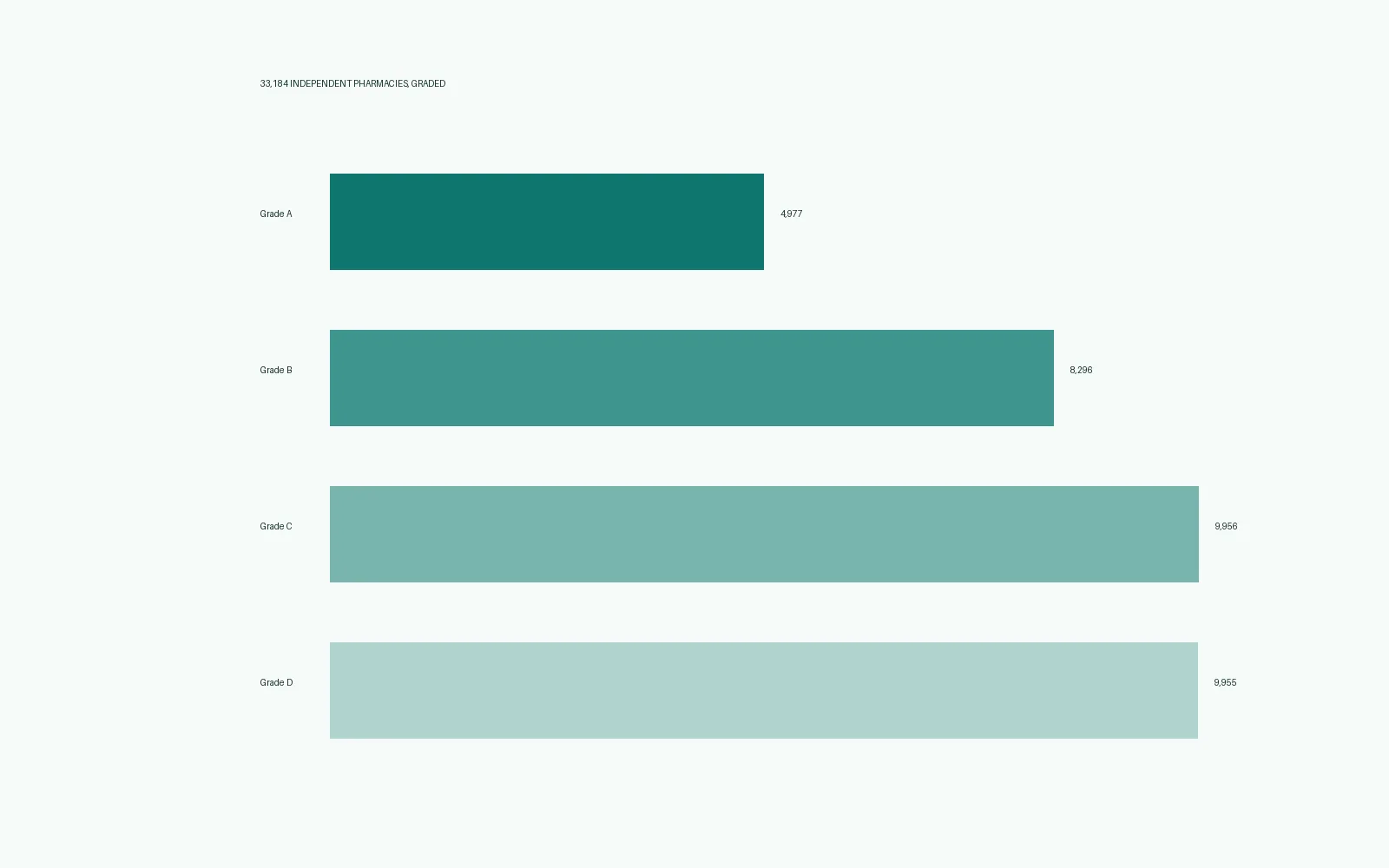
- 33,184pharmacies graded across 51 jurisdictions
- 4,977Grade A targets - 15% of the file, ranked
- 3commercial surfaces from a single build
- Not yet known
- —Meetings booked from the list
- —Deals closed against Grade A
- —Model accuracy against realized outcomes
Outreach outcomes belong to the parties who worked the list and were never reported back. The third is the interesting one: the exposure model ranks, and its ranking has never been scored against what actually happened to those stores. Until it is, the grades are a defensible hypothesis rather than a validated prediction.
"The deliverable was never the spreadsheet. It was the capability to produce it, priced three different ways."