One surface for a leadership group operating against moving data.
A four-person partnership running a multi-deliverable program needed to see itself in one place. The CSVs were never going to do it.
4
partners on one surface
no login churn - one password, four eyes
6 ↦ 1
deliverables consolidated
CSVs, decks, threads collapsed to a page
~20m
reclaimed per Monday
no more "which version is this"
6 wks
discovery to live
including identity layer
- The Brief
The leadership group was making decisions against a moving stack of CSVs, dashboards, and email threads. Every Monday meeting opened with twenty minutes of "wait, which version is this."
- Diagnosis
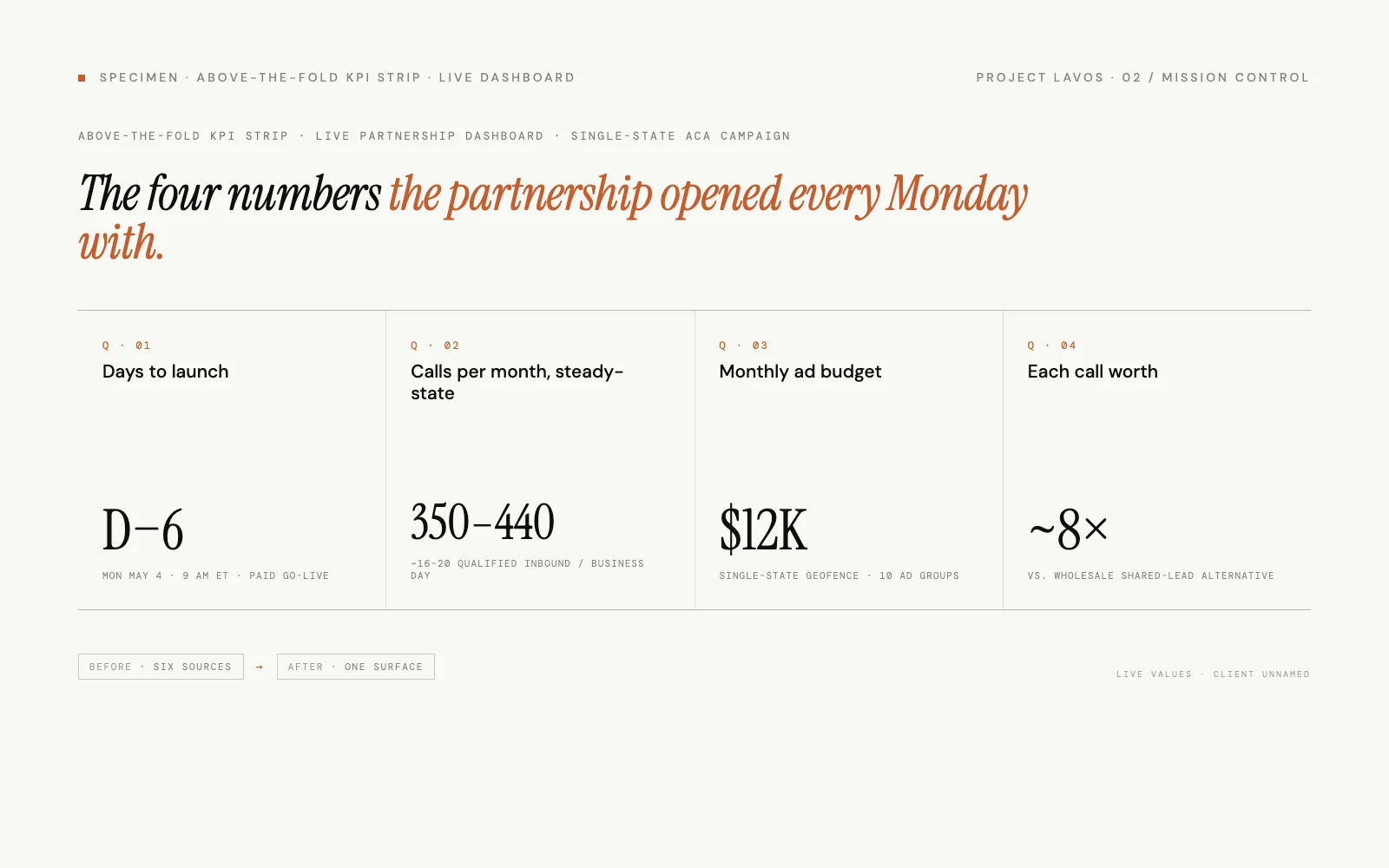
The data was right. What had to change was the shape it sat in. The team needed one surface to land on, not better files. A password-protected private dashboard, refreshed from the CSV pipeline they already trusted, with the four most-asked questions surfaced first.
- How I Read It
First-person · operator's note
My first read was that nobody on the partnership wanted another dashboard. They wanted to stop arguing about which tab was authoritative. So the design move wasn't "better visualizations" - it was fewer surfaces and higher trust. I refused to rebuild the data pipeline; the CSVs they had were fine. What needed rebuilding was the geometry on top of them. I gave the dashboard a small visual identity - typographic, monospace, chart-honest - so it would read as a tool rather than a deck someone was selling against. The 5-minute partner-onboarding loom existed for one reason: I needed to be off the call when the partnership argued.
- Process
- 01Week 1
Question audit
Two interviews per partner. Captured the seven questions actually asked of the data.
- 02Week 2
Wireframe
Top four questions placed above the fold. Tabular drill below.
- 03Week 3–5
Build
Private SPA, auto-refresh from existing CSV exports. Password gate.
- 04Week 6
Handoff
Identity layer applied. 5-minute partner onboarding loom recorded.
- The Build
01 · Question audit
Two interviews per partner. Output: the seven questions they actually asked the data, ranked by frequency and decision weight.
Twenty minutes per Monday were found and returned to the partnership.
02 · One surface
A private SPA - ranked answers above the fold, full tabular drill below. Auto-refresh from the existing CSV exports. Password gate, no login churn.
03 · Identity layer
A small visual identity for the dashboard itself - typographic, monospace, chart-honest. So the dashboard reads as a tool, not a deck.
"Four partners now argue against the same surface - which is the point of having one."
- Artifacts Delivered
- 01Mission control SPA (private, password-gated)
- 02Auto-refresh from CSV export pipeline
- 03Dashboard identity kit
- 04Partner-onboarding loom (5 min)
- Outcome
Monday meetings open with the surface, not the search. The partnership has a shared object to argue against - which is the point.
- Receipts
- 1shared surface, not four CSV exports
- 4/4partners onboarded inside one session
- 0data-pipeline rebuild - same trusted CSV source