Thirty-three editorial
plates.
The chord of the work. Each plate is a single-page study of one durable discipline. Three named practitioners. One template. Restraint as ethics. The colored period as commitment.
Plates
33
Cadence
Apr · May 2026
Discipline
Editorial folio
Form
Specimen plate
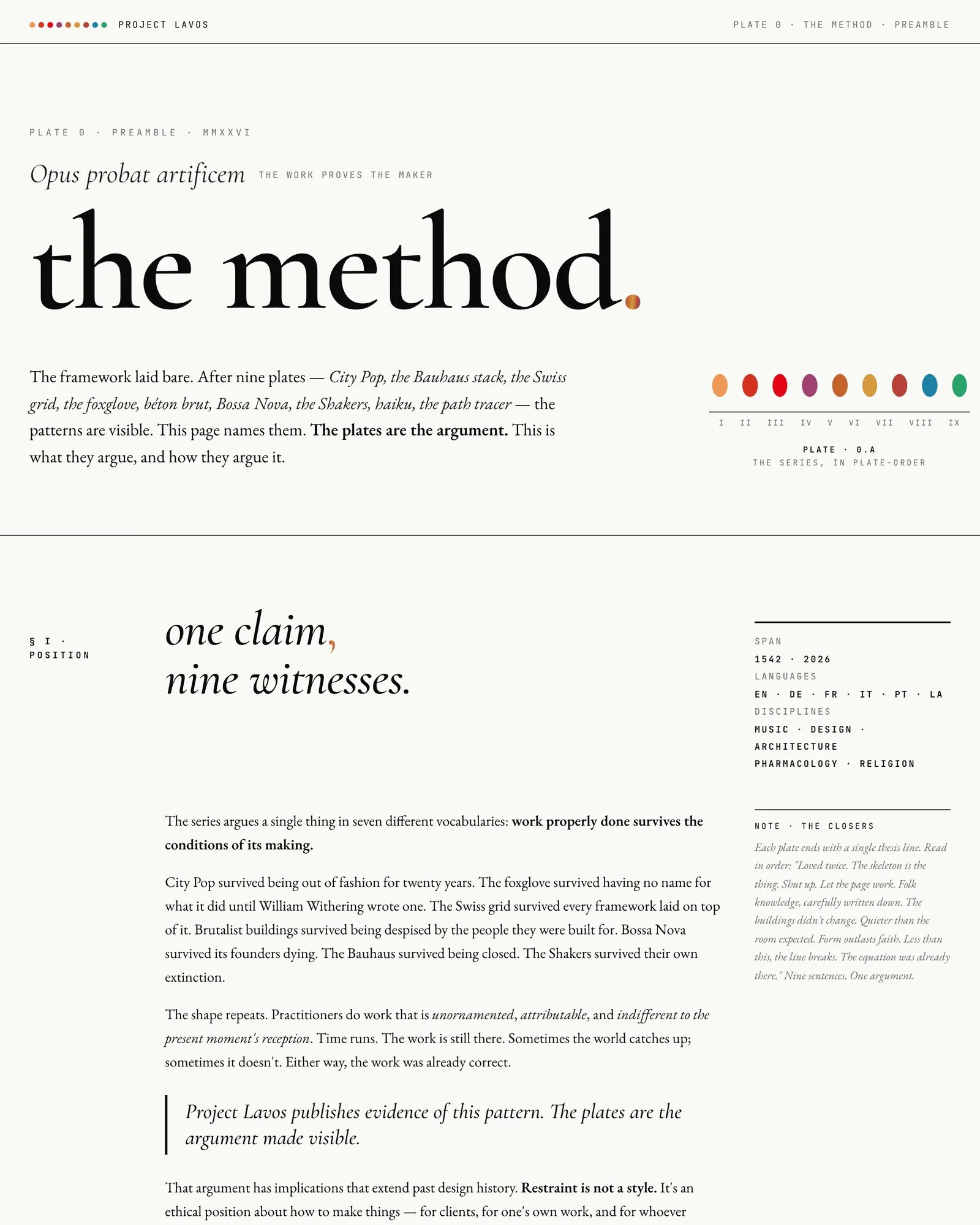 Plate 0Apr 2026
The Method.
Also a note- the work is the proof.
The framework laid bare. Three named witnesses, one template, restraint as ethics, the colored period as commitment. The editorial position the series argues, and the production discipline it practices.
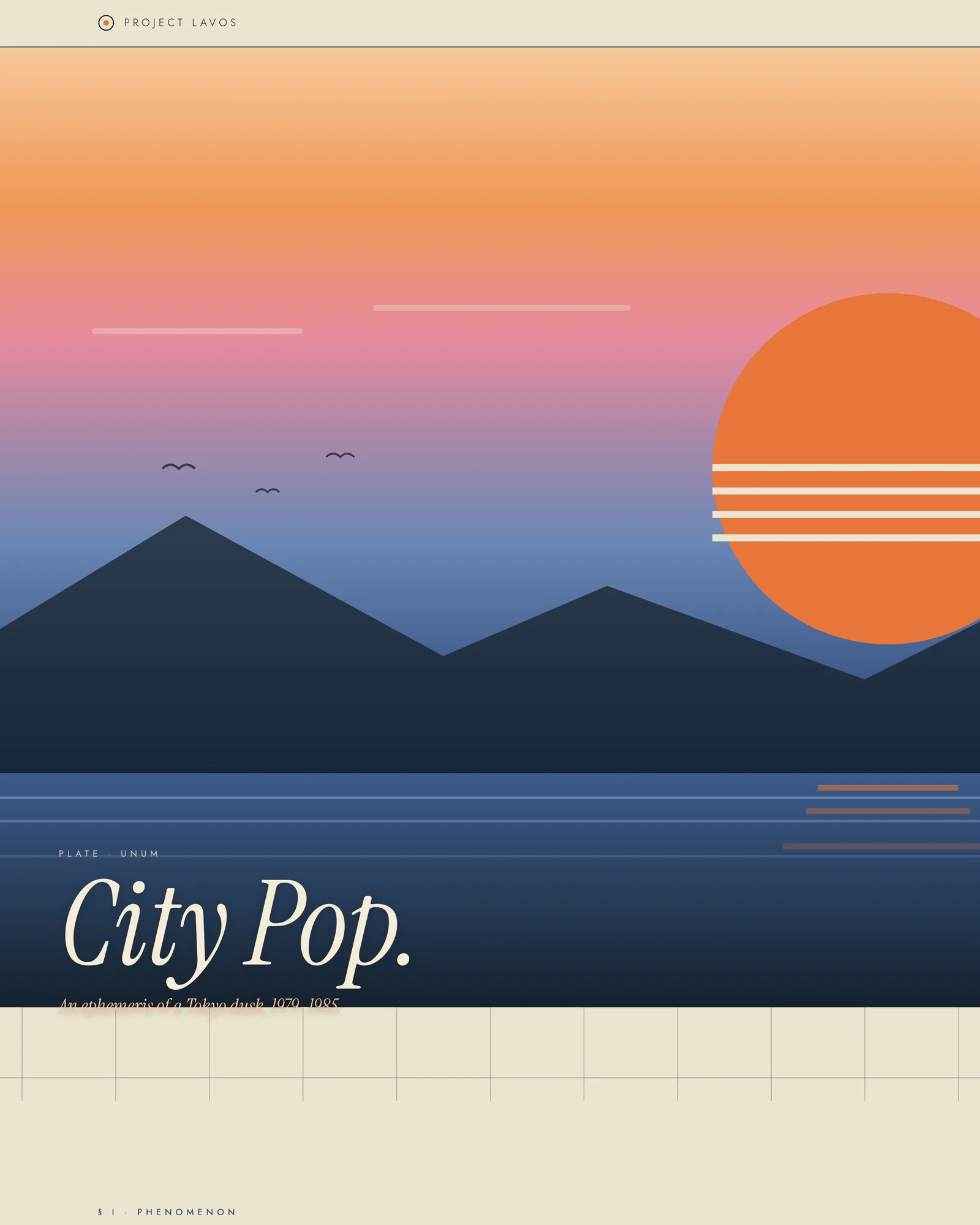 Plate IApr 2026
City Pop.
- loved twice.
An ephemeris of a Tokyo dusk, 1979–1985. The genre, its phenomenon, its anatomy, its three originators (Tatsuro Yamashita, Mariya Takeuchi, Hiroshi Nagai) set as a specimen plate.
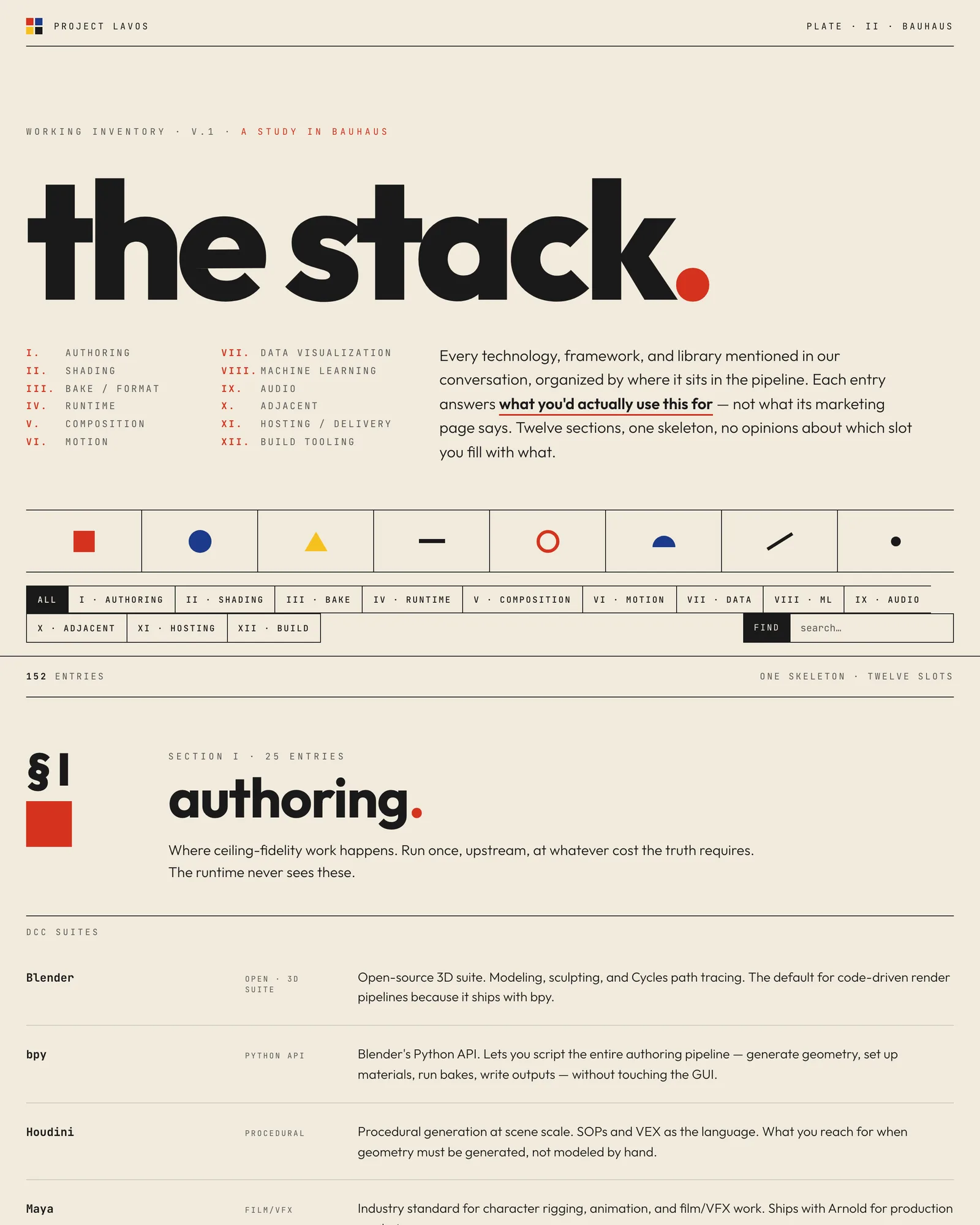 Plate IIApr 2026
The Stack.
- the skeleton is the thing.
A working inventory of the modern web rendering pipeline in twelve sections, rendered through the Bauhaus aesthetic. Primary palette, Kandinsky composition, lowercase wordmark.
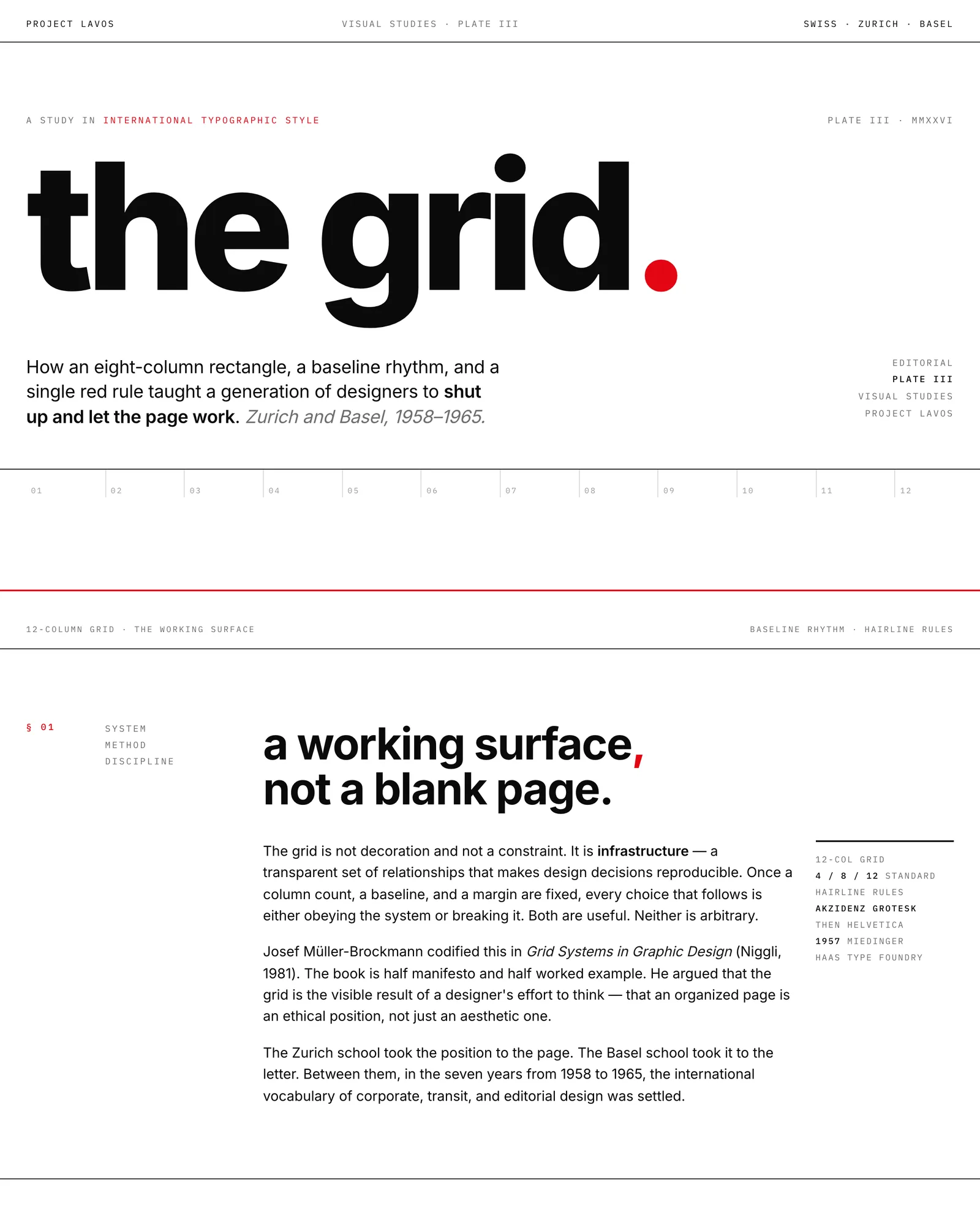 Plate IIIApr 2026
The Grid.
- shut up. let the page work.
How an eight-column rectangle, a baseline rhythm, and a single red rule taught a generation to shut up and let the page work. Müller-Brockmann, Ruder, Hofmann - Zurich and Basel, 1958–1965.
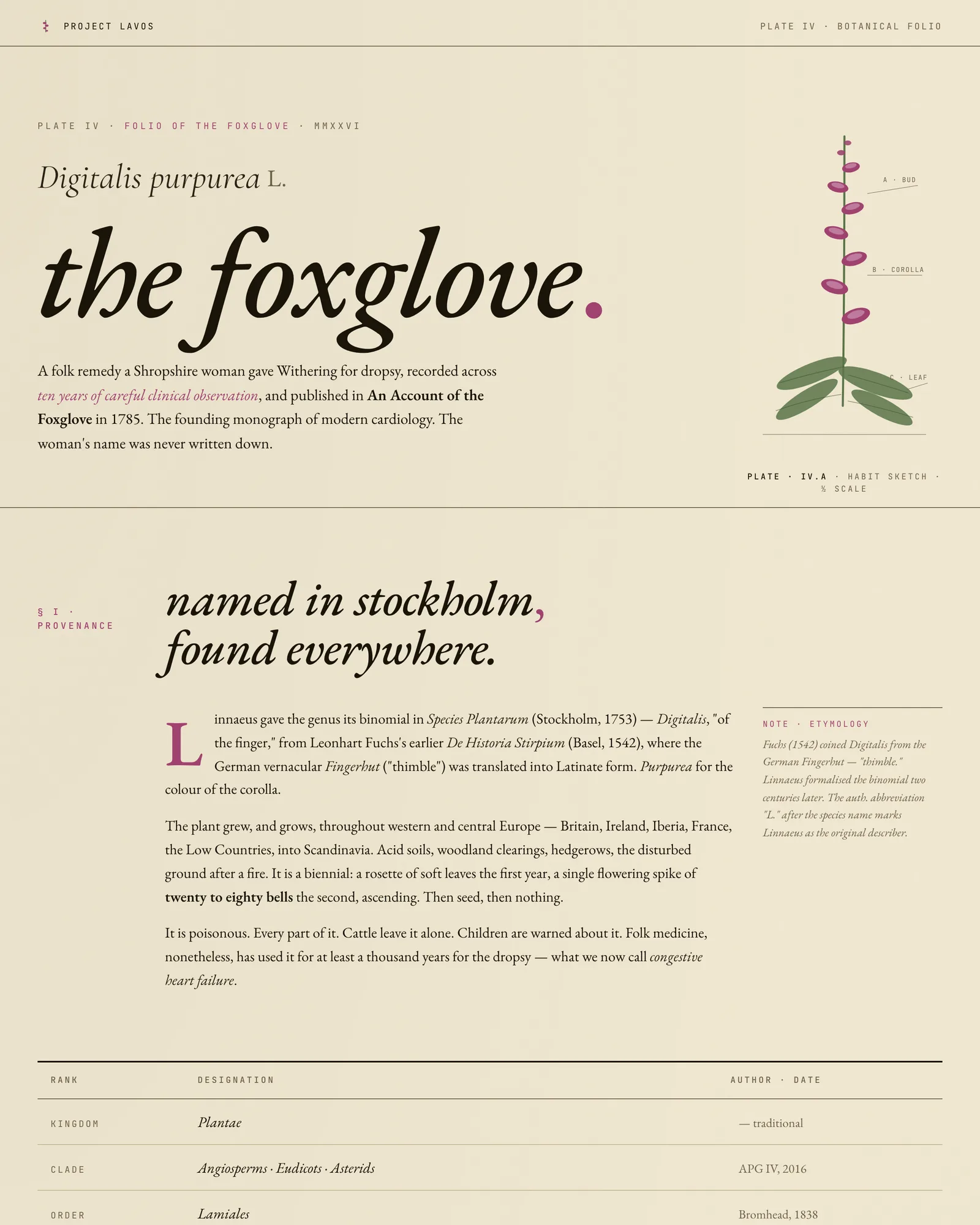 Plate IVApr 2026
Digitalis purpurea.
- folk knowledge, carefully written down.
A folio on the foxglove - the Shropshire folk remedy that William Withering's 1785 monograph turned into the founding text of modern cardiology. Linnaean classification, vernacular names, two centuries of clinical history.
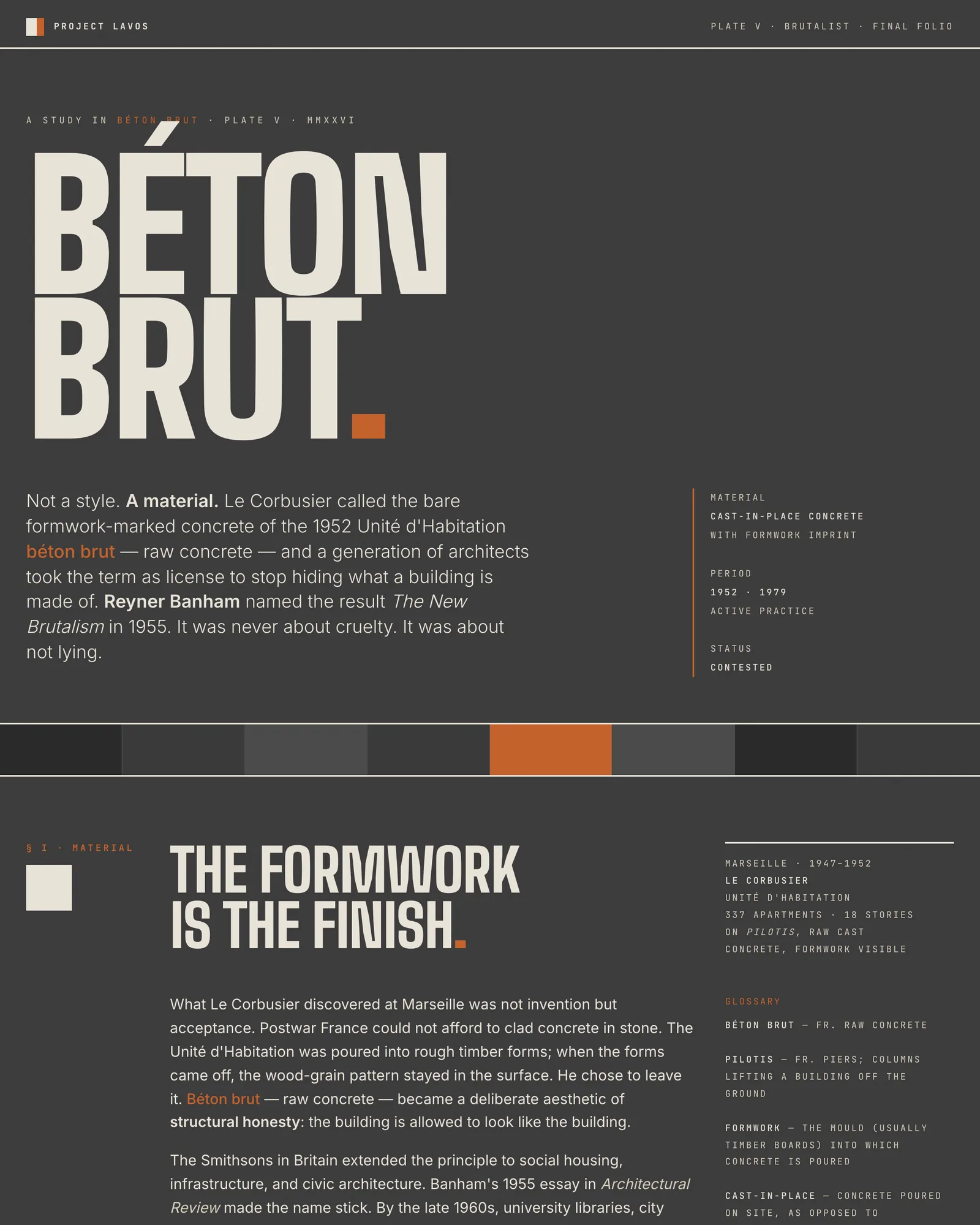 Plate VApr 2026
Béton Brut.
Also a note- the buildings didn't change.
Not a style. A material. Le Corbusier's 1952 Unité d'Habitation through the contemporary demolitions - nine real buildings, four architects, three statuses (extant, threatened, demolished).
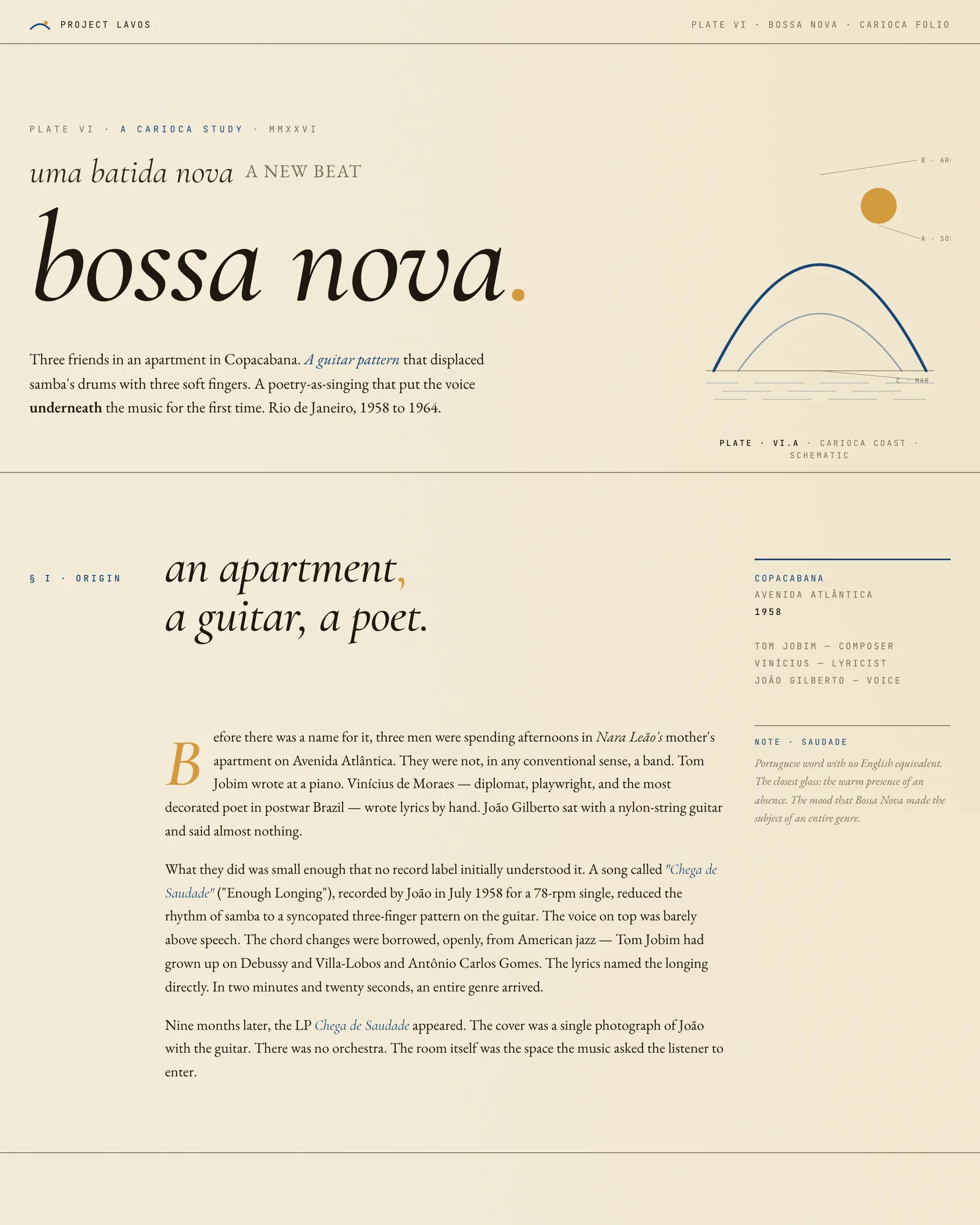 Plate VIApr 2026
Bossa Nova.
- quieter than the room expected.
Three friends in a Copacabana apartment between 1958 and 1964 who decided to sing more quietly than the room expected. João Gilberto, Tom Jobim, Vinícius de Moraes - the batida, the four founding records, the chamber music of pop.
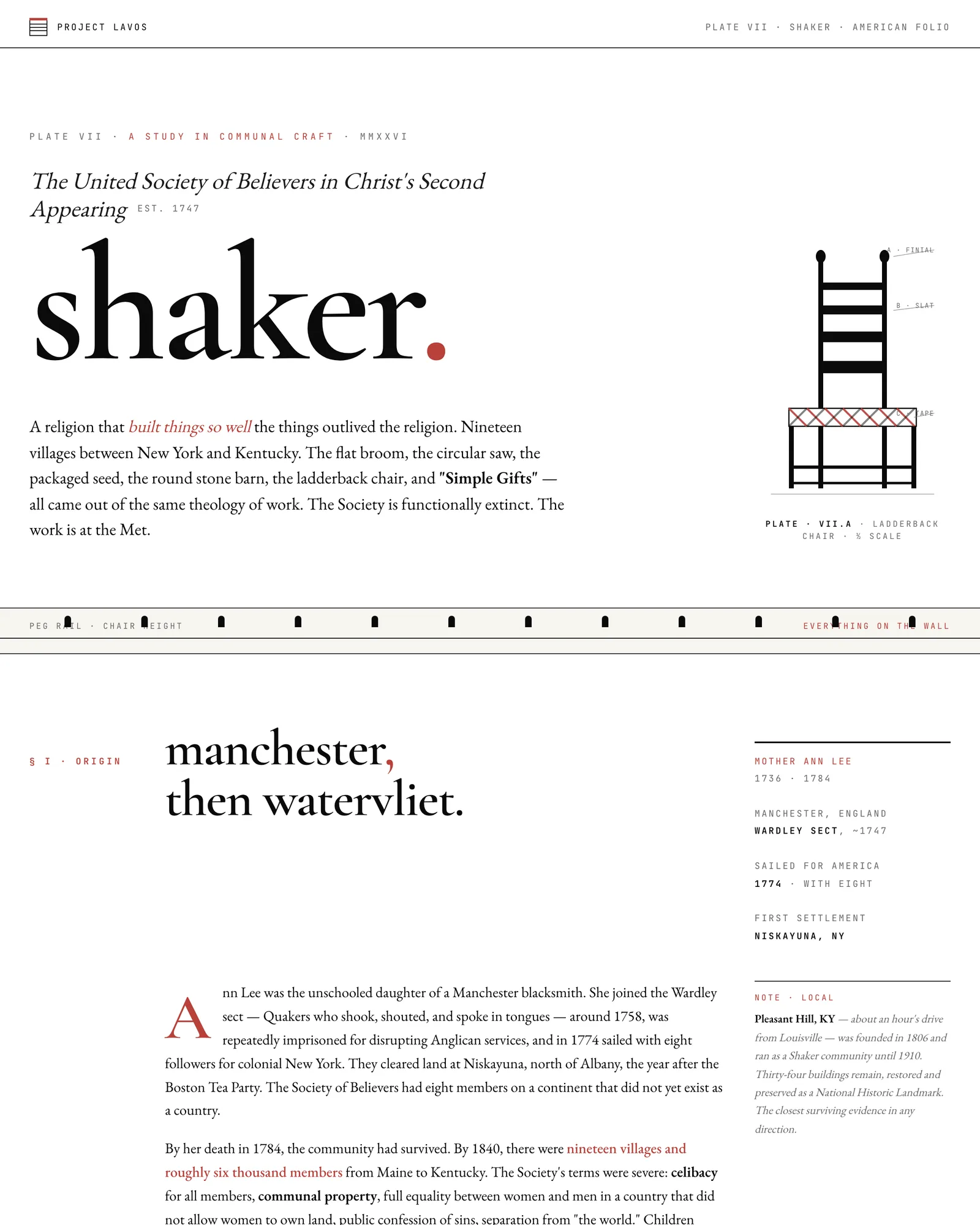 Plate VIIApr 2026
Shaker.
Also a note- form outlasts faith.
A religion that built things so well the things outlived the religion. Nineteen villages, the flat broom, the round stone barn, the ladderback chair, "Simple Gifts." United Society of Believers, 1747–present (functionally extinct). The chairs are at the Met.
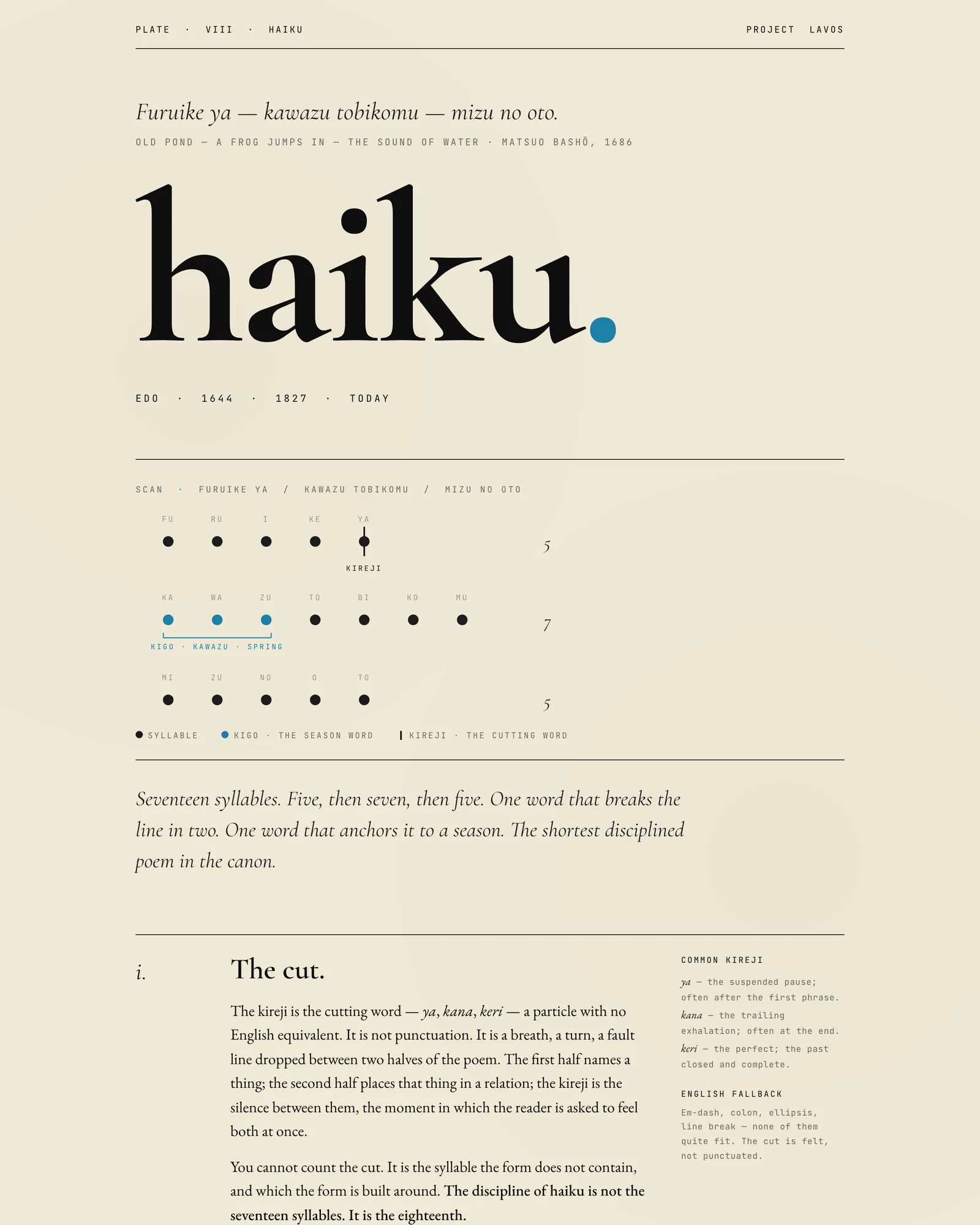 Plate VIIIApr 2026
Haiku.
- less than this, the line breaks.
Seventeen syllables. Five, then seven, then five. One word that breaks the line in two. One word that anchors it to a season. The shortest disciplined poem in the canon, passed unchanged through three masters in a hundred and fifty years - Bashō, Buson, Issa.
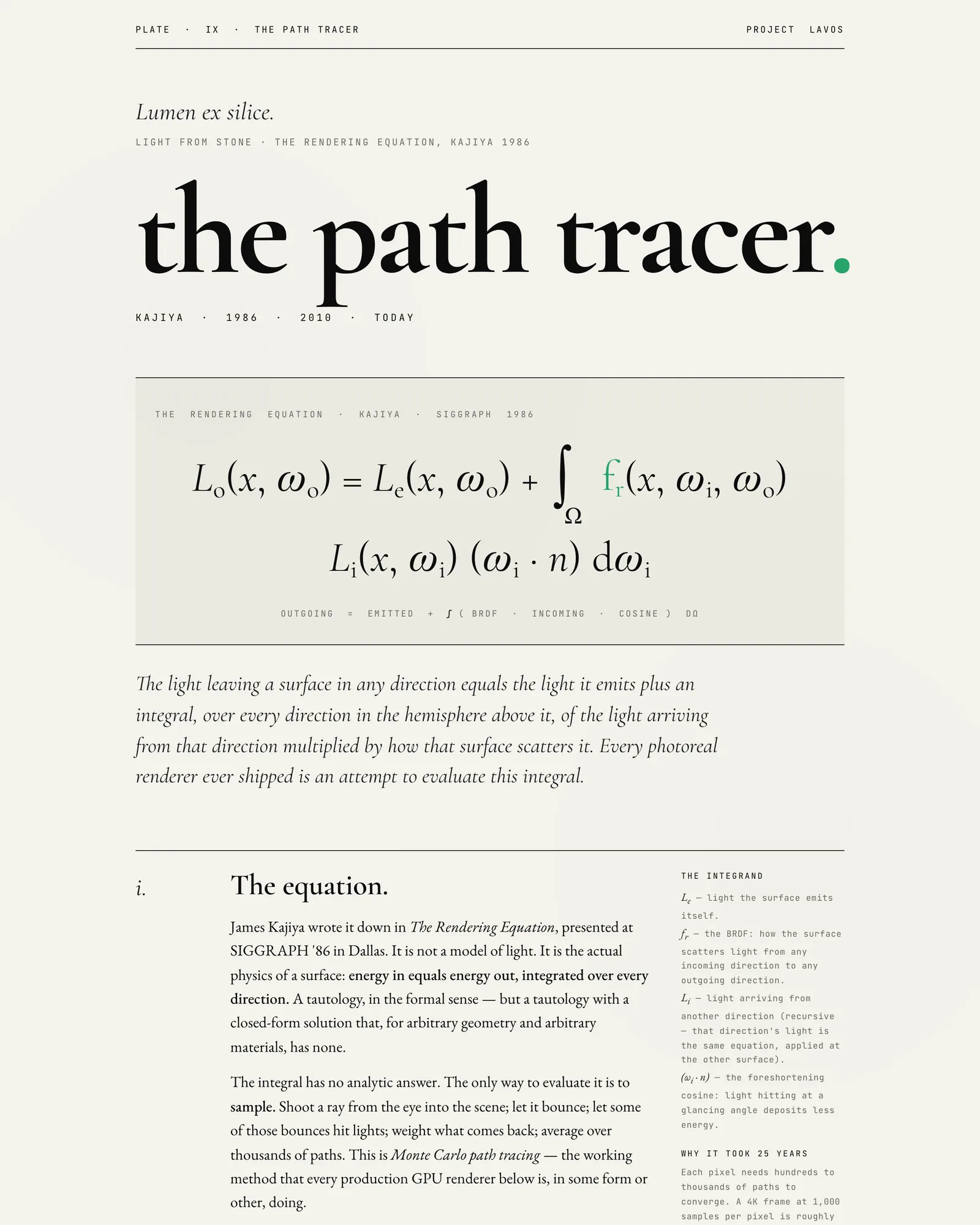 Plate IXApr 2026
The Path Tracer.
- the equation was already there.
Kajiya wrote the rendering equation in 1986. Twenty-five years later, silicon caught up. Octane (OTOY, 2010, spectral), Redshift (Maxon, 2014, biased), Cycles (Blender, 2011, open-source) - three GPU production renderers, one integral over the hemisphere.
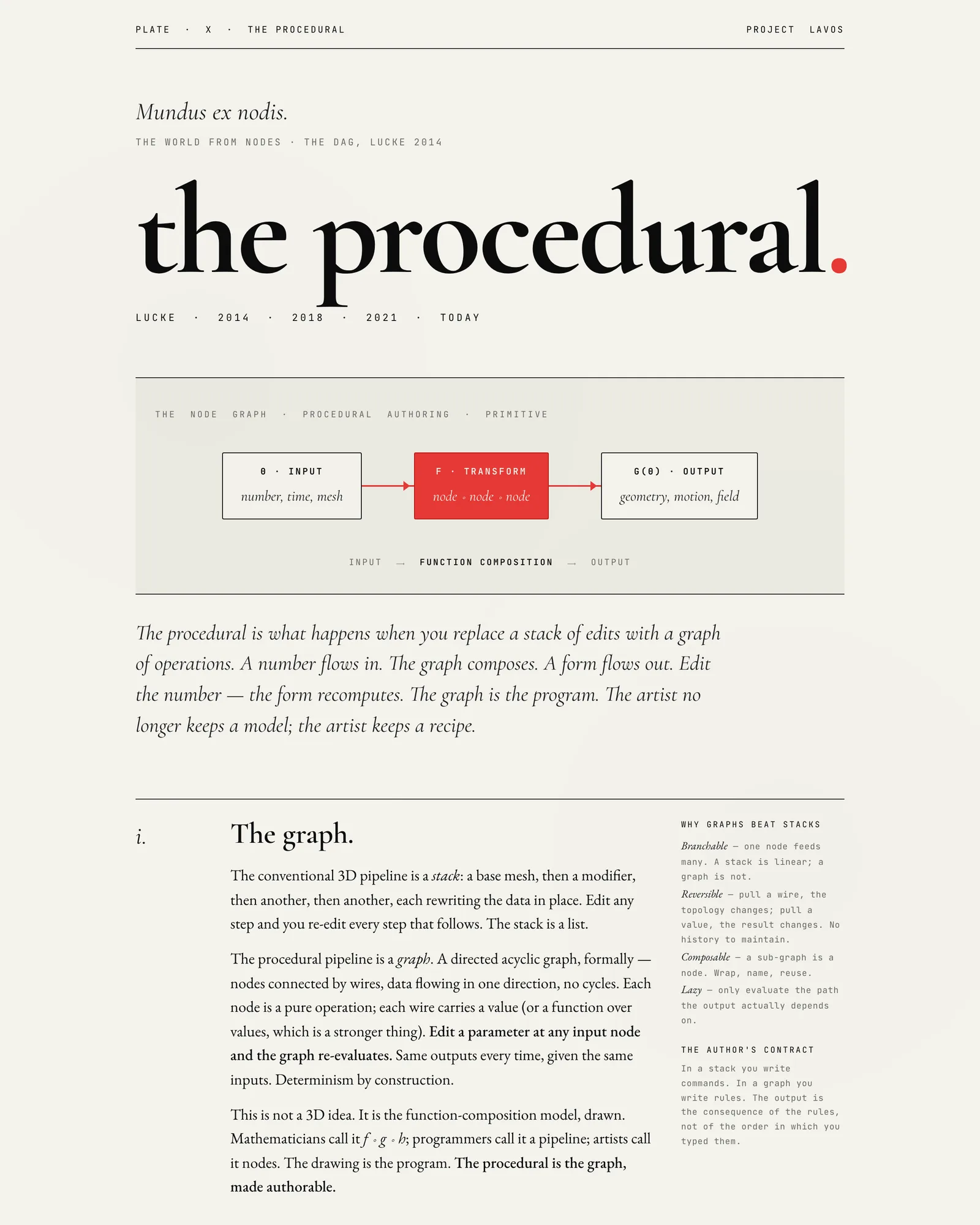 Plate XMay 2026
The Procedural.
- the addon became the engine.
Jacques Lucke wrote a Blender addon in 2014. The Foundation hired him in 2018. The addon became Geometry Nodes in 2021 - and Blender's modeling pipeline rebuilt around fields. Animation Nodes, Sverchok, Geometry Nodes - three node graphs, one author, one platform.
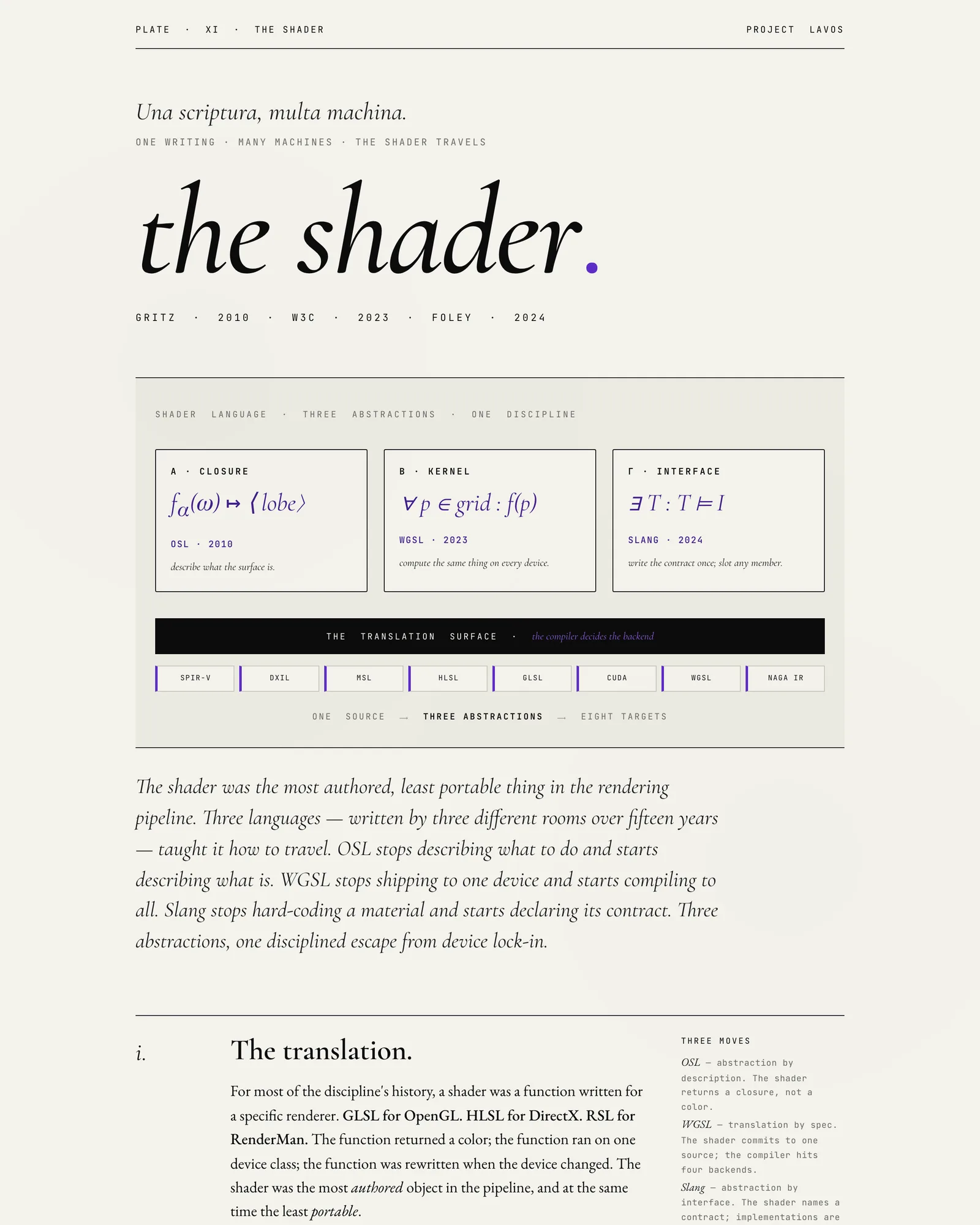 Plate XIMay 2026
The Shader.
- the shader is a description that travels.
OSL is a closure. WGSL is a kernel. Slang is an interface. Three shader languages, fifteen years, one disciplined escape from device lock-in. Larry Gritz at Sony Imageworks (2010), the W3C GPU group (2023), Tim Foley at NVIDIA (2024).
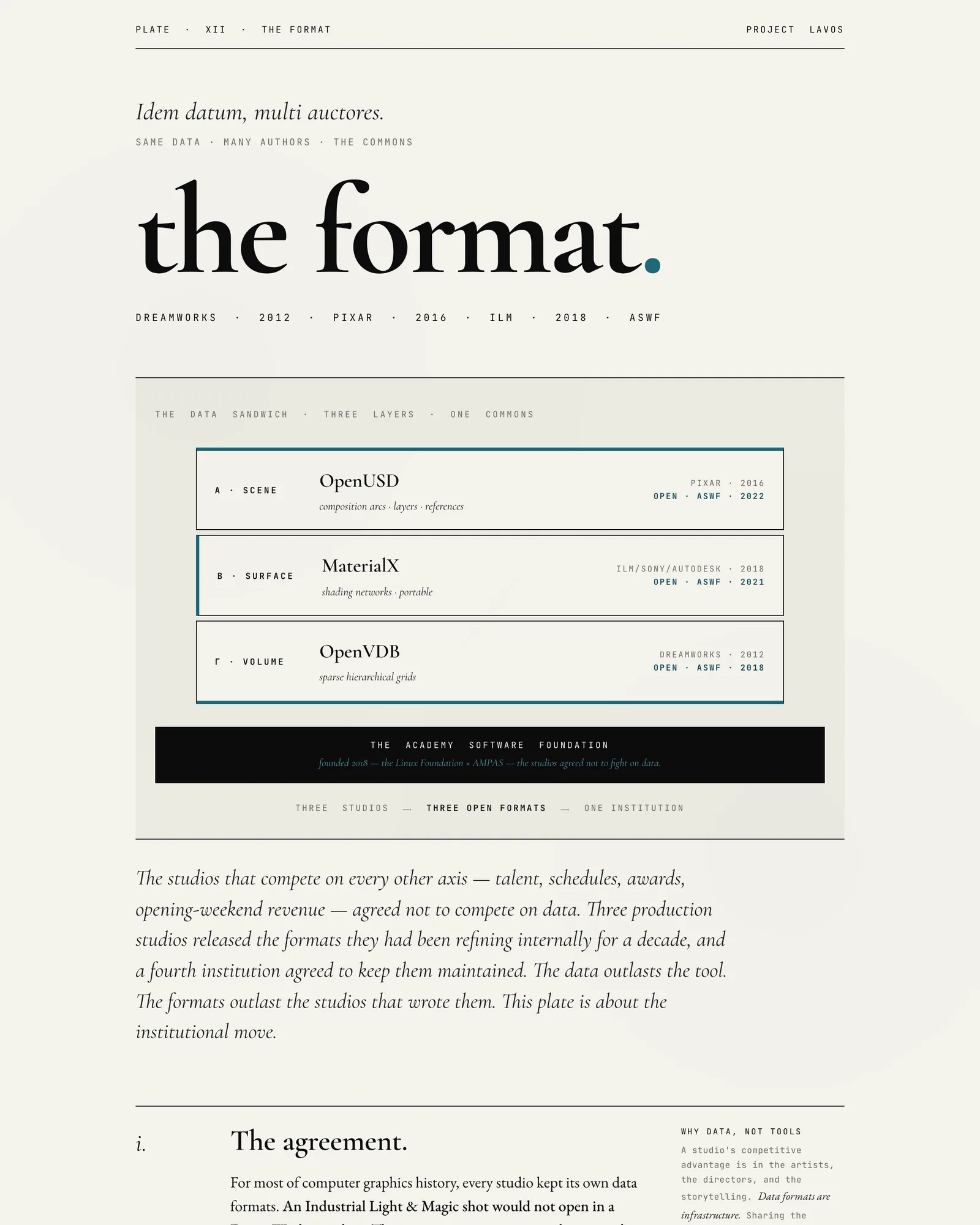 Plate XIIMay 2026
The Format.
- the format outlasts the tool.
OpenVDB (DreamWorks 2012), OpenUSD (Pixar 2016), MaterialX (ILM 2018) - three open formats, three studios, one institution. The studios that compete on every other axis agreed not to compete on data. The Academy Software Foundation, founded 2018, holds the maintenance.
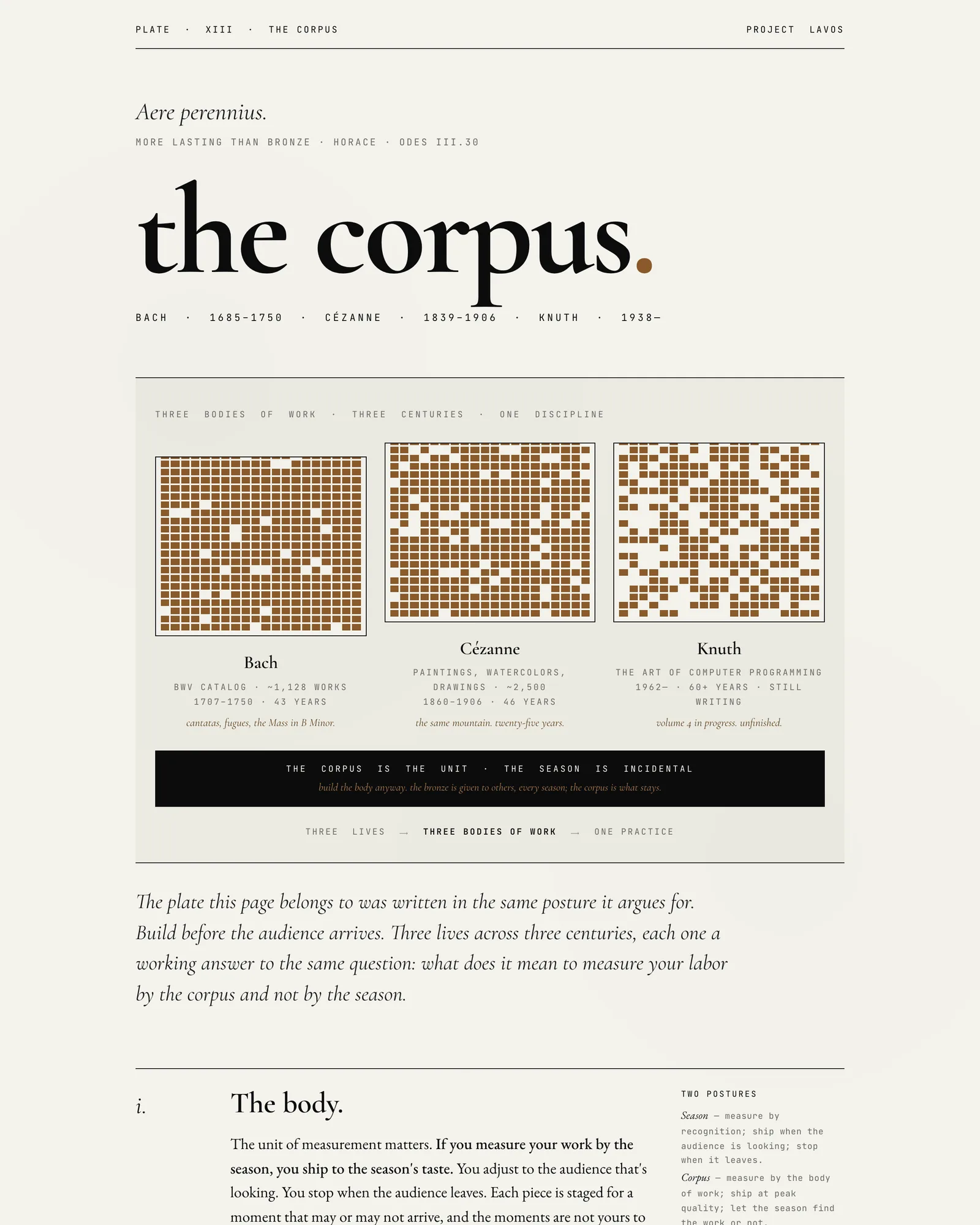 Plate XIIIMay 2026
The Corpus.
- aere perennius.
Bach (1,128 BWV works), Cézanne (~2,500 paintings, watercolors, drawings), Knuth (60+ years on TAOCP, still writing) - three bodies of work built independent of the season that justified them. The corpus is the unit; the audience is incidental.
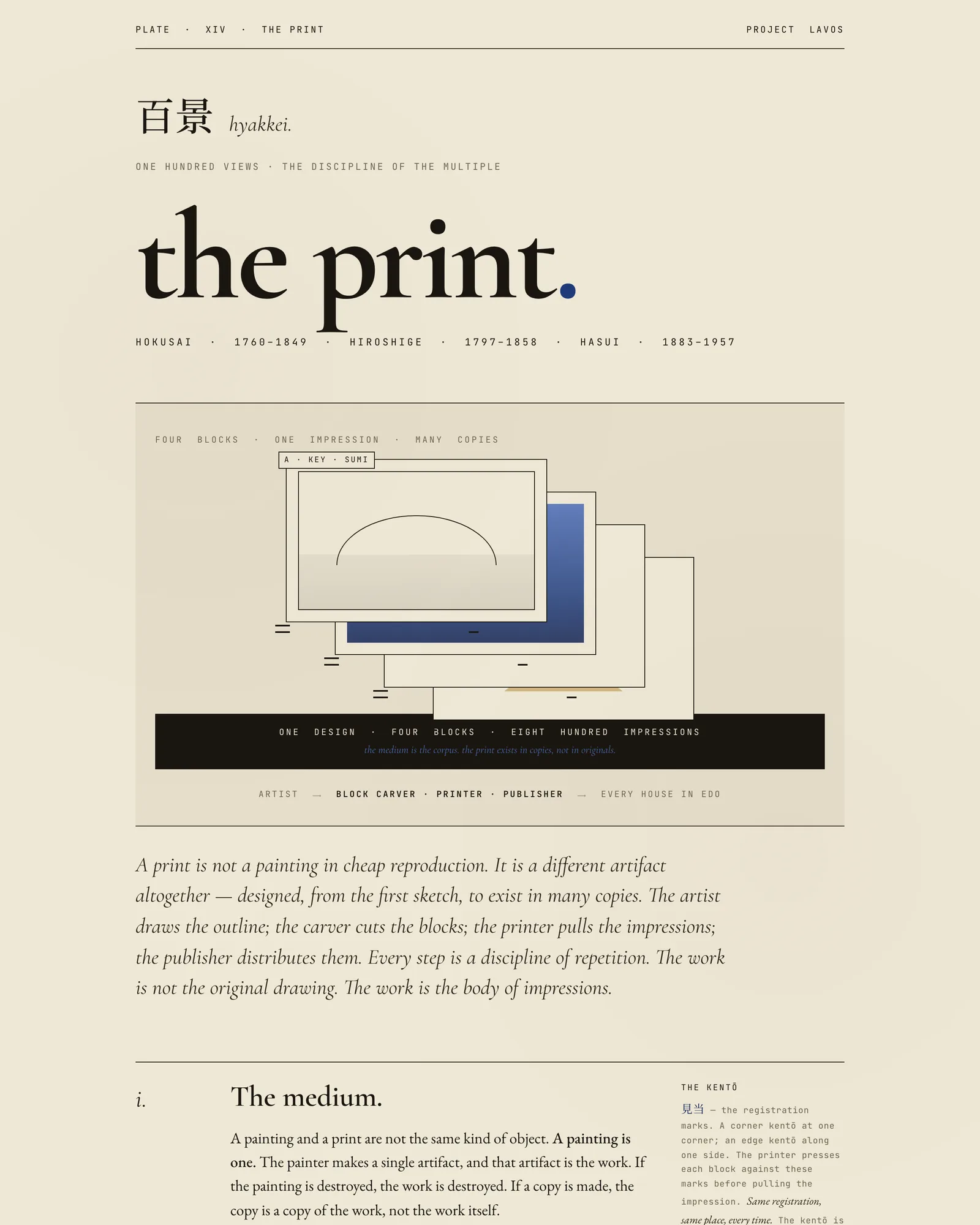 Plate XIVMay 2026
The Print.
- one impression, many copies.
Hokusai (1760–1849), Hiroshige (1797–1858), Hasui (1883–1957) - three Japanese printmakers across two and a half centuries of woodblock. The discipline of the multiple: artist draws, carver cuts, printer pulls, publisher distributes. Four blocks, one impression, many copies.
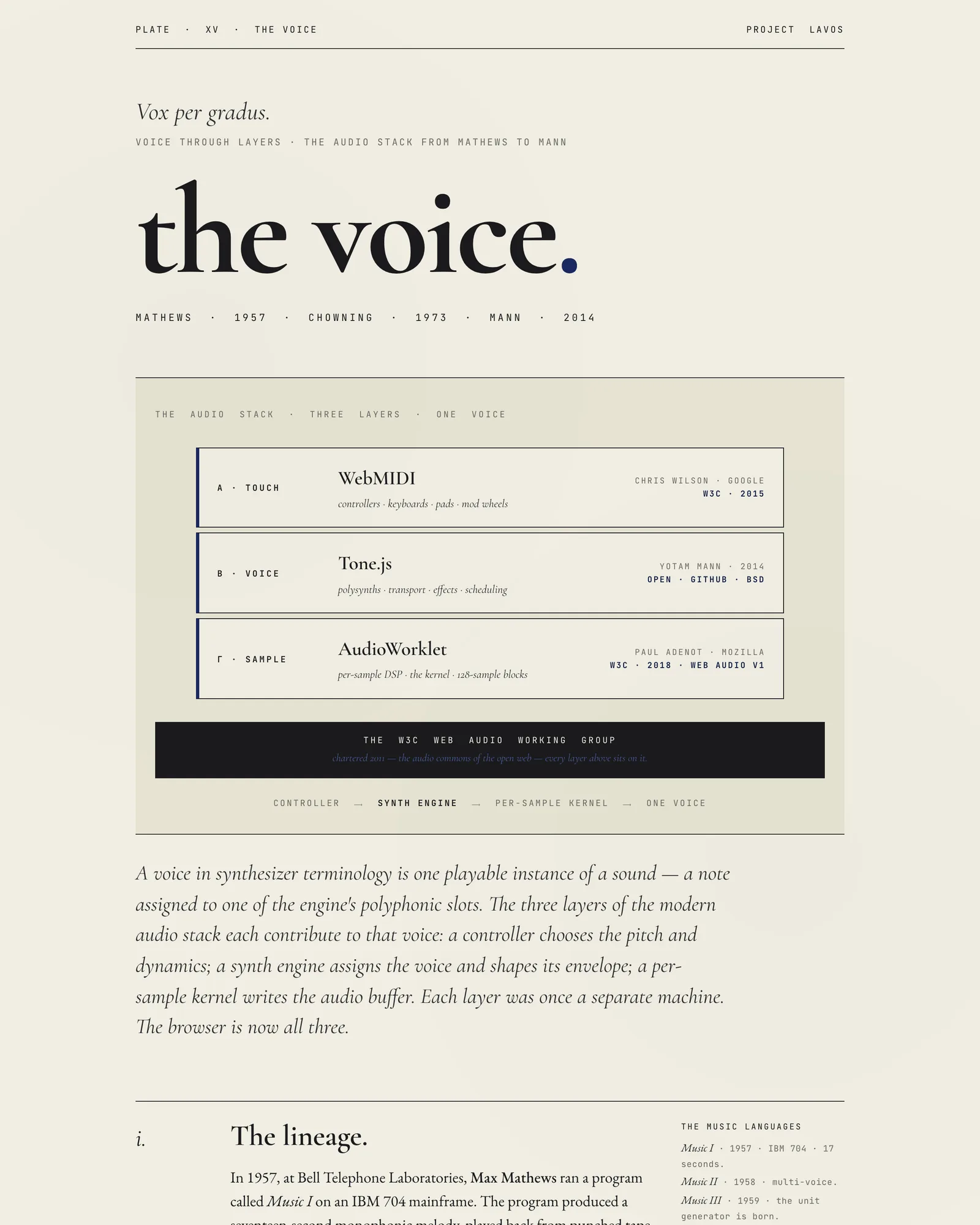 Plate XVMay 2026
The Voice.
- vox per gradus.
Max Mathews (Bell Labs, 1957, Music I) → John Chowning (Stanford CCRMA, 1973, FM synthesis) → Yotam Mann (Tone.js, 2014, the browser). Three lives, three eras, one stack: WebMIDI for touch, Tone.js for voice, AudioWorklet for the per-sample kernel.
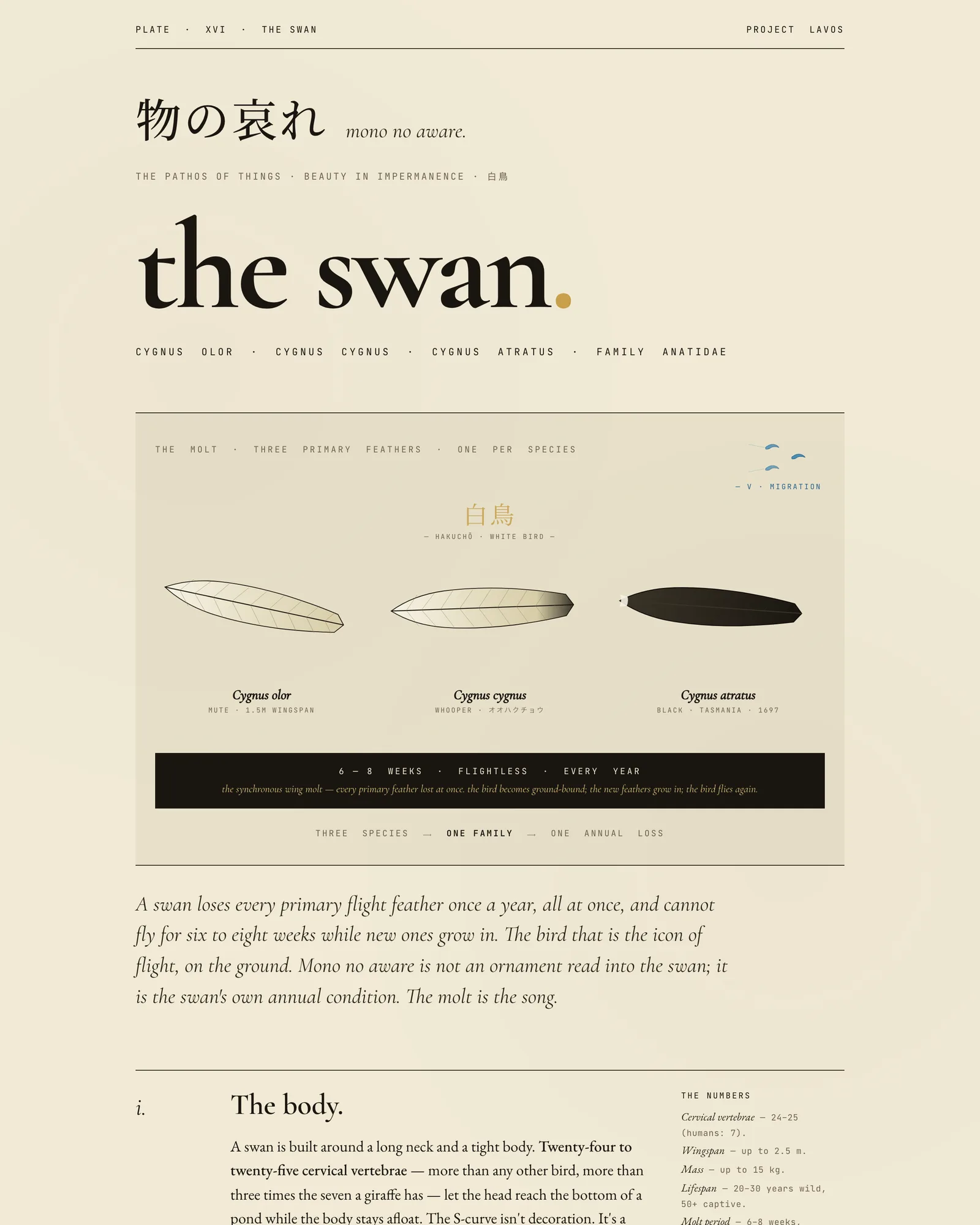 Plate XVIMay 2026
The Swan.
- the molt is the song.
Three swan species - Cygnus olor (Mute, the European emblem), Cygnus cygnus (Whooper, the Manyōshū migrant), Cygnus atratus (Black, the Australian outlier) - read through 物の哀れ, mono no aware: the pathos of things, beauty in impermanence.
- Plate XVIIMay 2026
The Keepers.
two ends of the spectrum.
The Keepers.
- two ends of the spectrum.
Two patterns from a thirty-two-pattern listening test. El Estepario Siberiano on Meshuggah’s Bleed (152 BPM, locked pocket, dynamics CV 0.23) and on The Weeknd’s Blinding Lights (172 BPM, wide pocket, CV 0.58, 25% ghost ratio). Same hands. The vocabulary is the same; the pocket is not. A specimen of curation: which transients earn their keep.
- Plate XVIIIMay 2026
Ars Temporis.
the constraint is the mechanism.
Ars Temporis.
- the constraint is the mechanism.
Latin: the art of time. Christiaan Huygens (the pendulum clock, The Hague, 1656) → John Harrison (the marine chronometer, H1 1735 through H4 1759, London) → Abraham-Louis Breguet (the tourbillon, Paris, 1801). Three mechanisms across one hundred forty-five years; three men who refused to argue with a physical constraint and instead built it into the movement. Huygens worked with amplitude. Harrison worked with the sea. Breguet worked with gravity. The substrate has changed - NTP drift, monotonic clocks, leap seconds - but the discipline has not. The page is a working escapement; edit the parameters and watch the regulator respond. Inheritance from Plate II (the GLSL specimen): edit the source, the image recompiles → edit the parameter, the mechanism responds.
- Plate XIXMay 2026
Astrolabe.
the sky is the instrument.
Astrolabe.
- the sky is the instrument.
The celestial sphere encoded in a brass disc. Hipparchus of Nicaea (Rhodes, c. 150 BCE) chose the south celestial pole as the projection point and proved stereographic projection preserves angles; circles on the sphere stay circles on the plane. Abū Isḥāq al-Zarqali (Toledo, 1081) refined the saphaea so a single plate served every latitude - the constraint of place absorbed into the geometry itself. Three hundred years later Geoffrey Chaucer (London, 1391) wrote his ten-year-old son a treatise on it - the first scientific text in English. Three witnesses across fifteen hundred years; the same instrument, the same math built into the geometry. The substrate became silicon; the discipline did not. The page shows the Toledo climate plate - true stereographic projection of the celestial sphere onto brass, with the rete rotating slowly above it the way the sky turns over a fixed observer.
- Plate XXMay 2026
Sphaera Mundi.
the planets keep time.
Sphaera Mundi.
- the planets keep time.
The solar system rendered in brass. The astrolabe showed the sky from below - a stereographic projection onto a flat disc. The orrery shows it from above - a tabletop model of the planets on rings, each at its correct relative orbital period. Eratosthenes of Cyrene (Alexandria, c. 240 BCE) measured Earth's circumference within one percent and gave the cosmos a scale. George Graham (London, 1704) built the first geared mechanical solar system for Charles Boyle, 4th Earl of Orrery, whose name the object still carries. James Ferguson (Edinburgh, 1750) took it from the noble's library to the lecture hall and published the diagrams that taught a century how to see the planets. Six bodies on six brass rings, a central sun on a brass pillar, a glass dome above; the seventeen-note A-harmonic-minor sweep that overlaid Plate XIX now fires on visible planet motion - Kepler's music of the spheres made audible.
- Plate XXIMay 2026
Specimen.
the letter is the instrument.
Specimen.
- the letter is the instrument.
The typeface as instrument. The astrolabe encoded the celestial sphere in geometry; the typeface encodes language in geometry. Every letterform is a path; every weight is a parameter; every italic is a slant transform. Claude Garamond (Paris, 1545) cut the first French roman and set the European standard for two centuries. William Caslon (London, 1722) cut the English answer - sturdier, more open; the Declaration of Independence was set in Caslon. Giambattista Bodoni (Parma, 1798) cut the first modern roman, mathematical and high-contrast; every Vogue nameplate descends from him. Five hundred years of foundries; one continuous discipline. The plate is a typographic specimen, built in anime.js + SVG + a variable serif (Crimson Pro, 200–900 weight axis), as the editorial register the foundries used to demonstrate what their typefaces can do.
- Plate XXIIMay 2026
Manus.
the instrument is the body.
Manus.
- the instrument is the body.
The hand. Twenty-seven bones, thirty-four muscles, more articulating geometry per cubic inch than anything else in the body - the part that builds every other instrument. Galen of Pergamon (Rome, c. 170 CE) described it from Barbary macaques because Roman law forbade human dissection, and his version dominated medicine for thirteen hundred years until it was corrected. Andreas Vesalius (Padua, 1543) dissected actual human cadavers and published De Humani Corporis Fabrica with the first anatomically correct hand plates in the Western tradition. Bernhard Siegfried Albinus (Leiden, 1747) produced Tabulae sceleti et musculorum corporis humani - muscles peeled back in successive layers against landscape backgrounds, the most beautiful anatomical plates ever made. The plate is an écorché: bones, tendons, carpals, retinaculum, articulating through a flexion-extension cycle against a parchment ground bearing Latin labels in numbered keys.
- Plate XXIIIJuly 2026
Firmamentum.
the oldest light has no timestamp.
Firmamentum.
- the oldest light has no timestamp.
The body of work drawn as a sky, and the sky read as an argument. At the pole: the guitar, which has no repository and no timestamp - the one unmeasured thing, which everything measured turns around. The constellations follow Lacaille, who filled the unnamed southern sky with instruments instead of heroes - a claim that what deserves writing on the heavens is not what a life worships but what a life does. Here: the lyre, the watchtower, the press, the bridge, the hearth, one cluster born in a single season. The engagements cross as bright unnamed wanderers on the ecliptic; they leave and return, and a practice that mistakes its planets for its stars has no sky left when they set. Most plotted lights are faint, kept on Bode's principle that the field is the fact - nobody sees a figure except against the lesser stars. The projection is polar for 38.25 N, so the innermost practices are circumpolar and never set. One dashed circle holds a place for a light expected in August. Hevelius engraved his atlas twice because the fire took the first; the catalog rebuilds from the work, never the reverse. Measured from the git log; the mechanics stay in the caption.
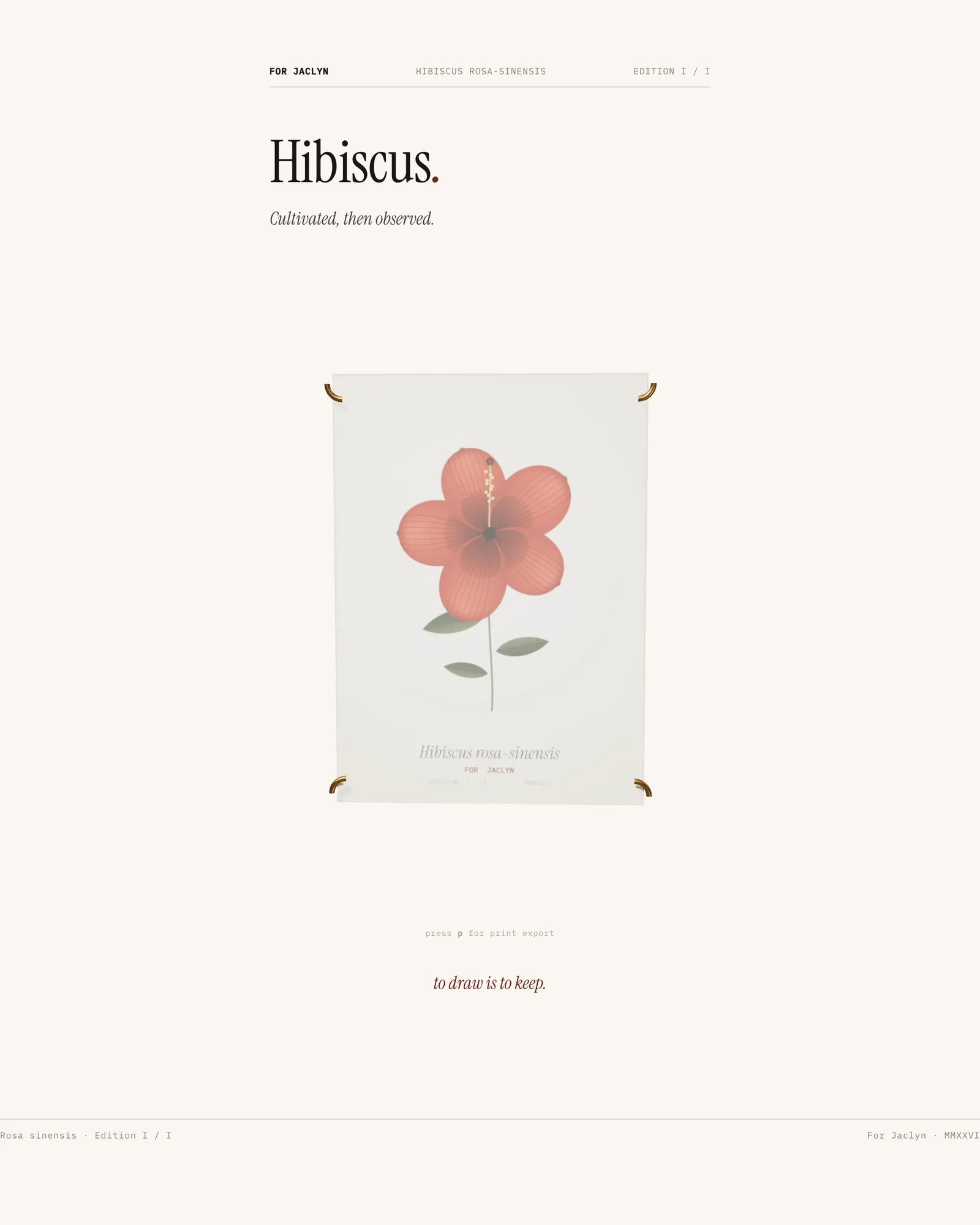 Plate XXIVJuly 2026
Rosa sinensis.
- cultivated, then observed.
Hibiscus rosa-sinensis. The cultivated flower held to the same glass as the wild specimens. Cultivated, then observed.
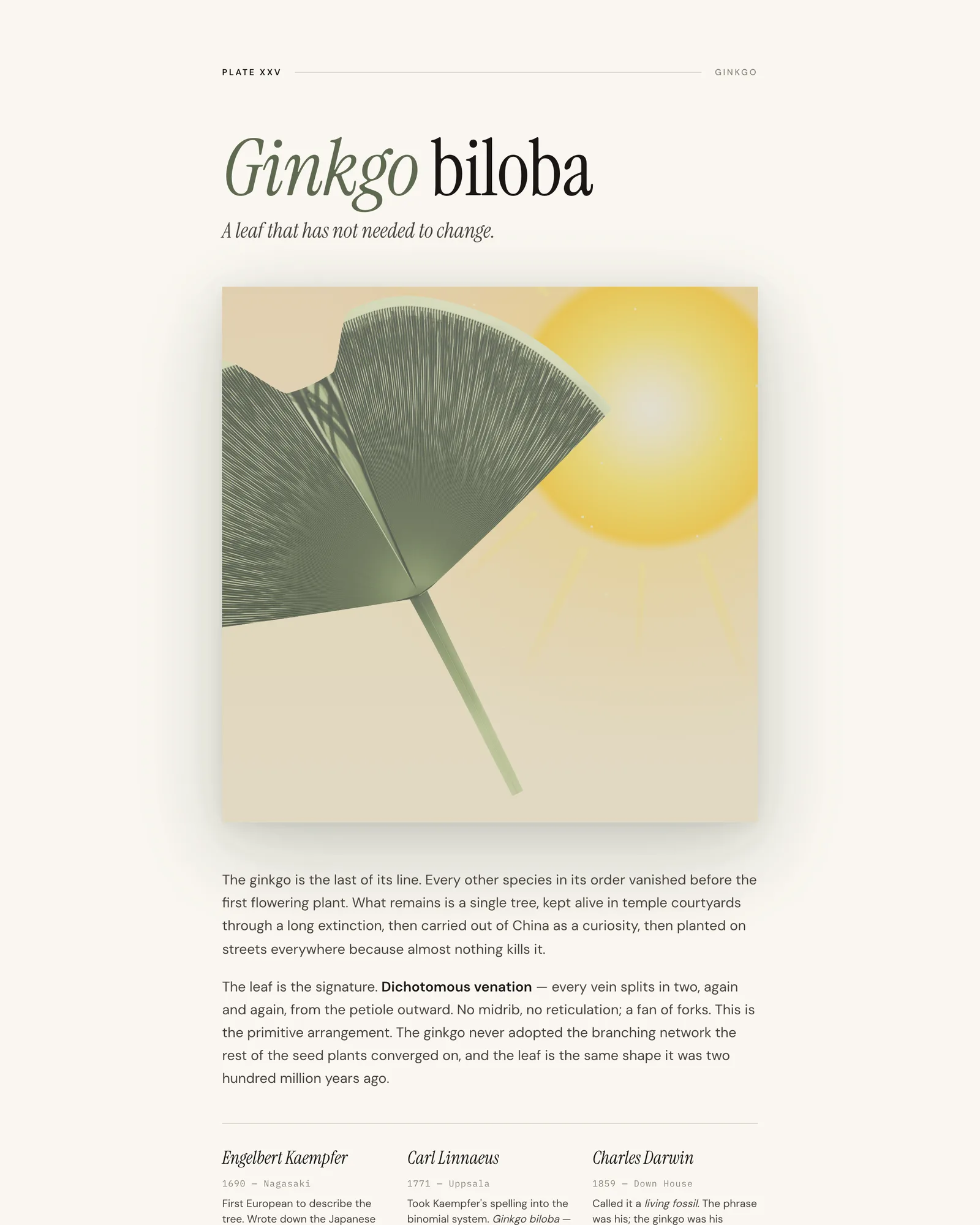 Plate XXVJuly 2026
Ginkgo.
- the fan remembers the fork.
Ginkgo biloba. A single leaf; a fan that remembers the fork. Kaempfer, Linnaeus, Darwin - three witnesses to a tree that survived its own extinction.
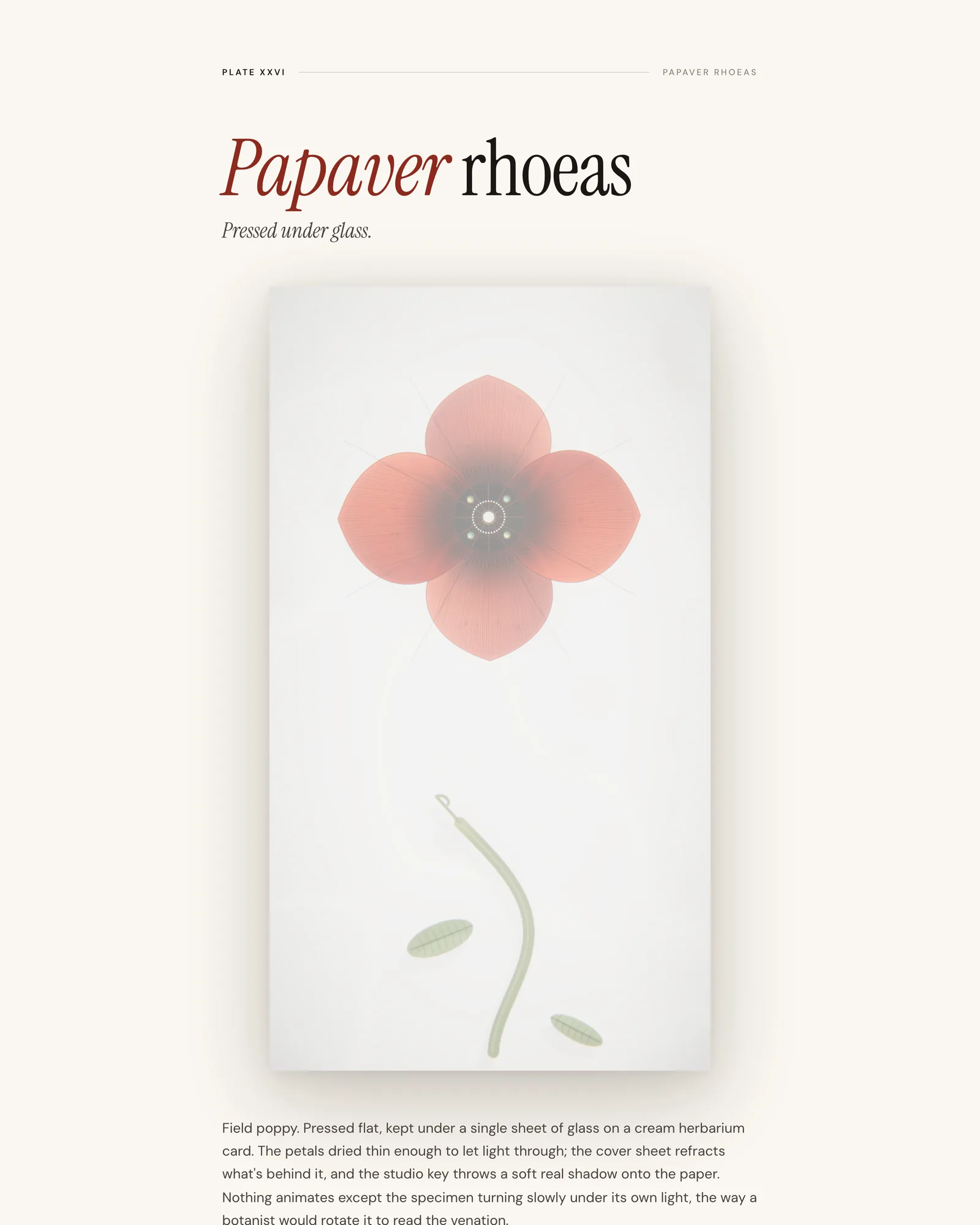 Plate XXVIJuly 2026
Papaver rhoeas.
- held still, against time.
Pressed common poppy under glass. Cream paper, real cast shadow, a sapphire-IOR cover sheet refracting through to the lamina.
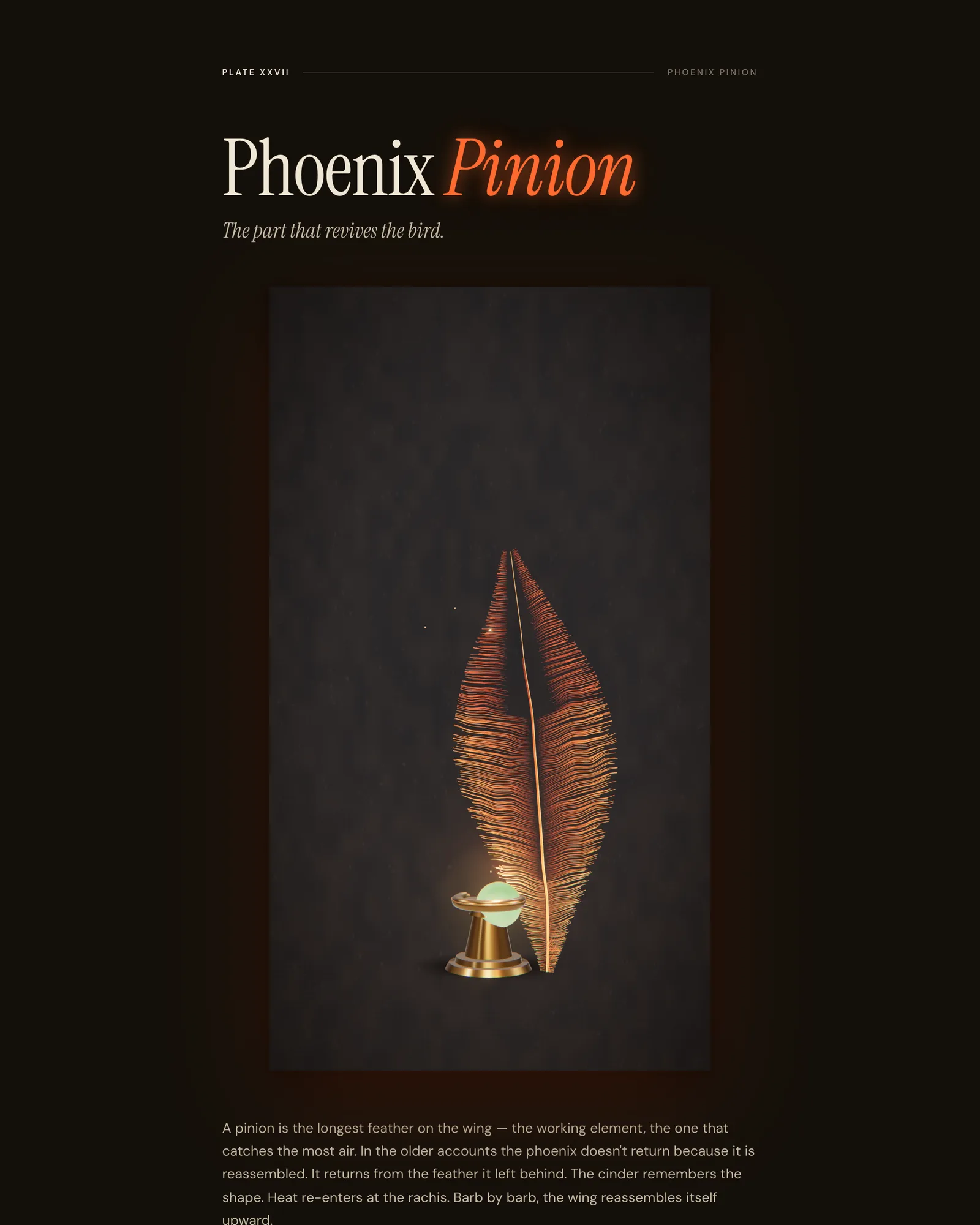 Plate XXVIIJuly 2026
Phoenix Pinion.
- place the relic in the right vessel - and the vessel answers.
A single phoenix pinion. The feather as the part that revives the bird. Inanna, Persephone, Lazarus - three witnesses to descent and return.
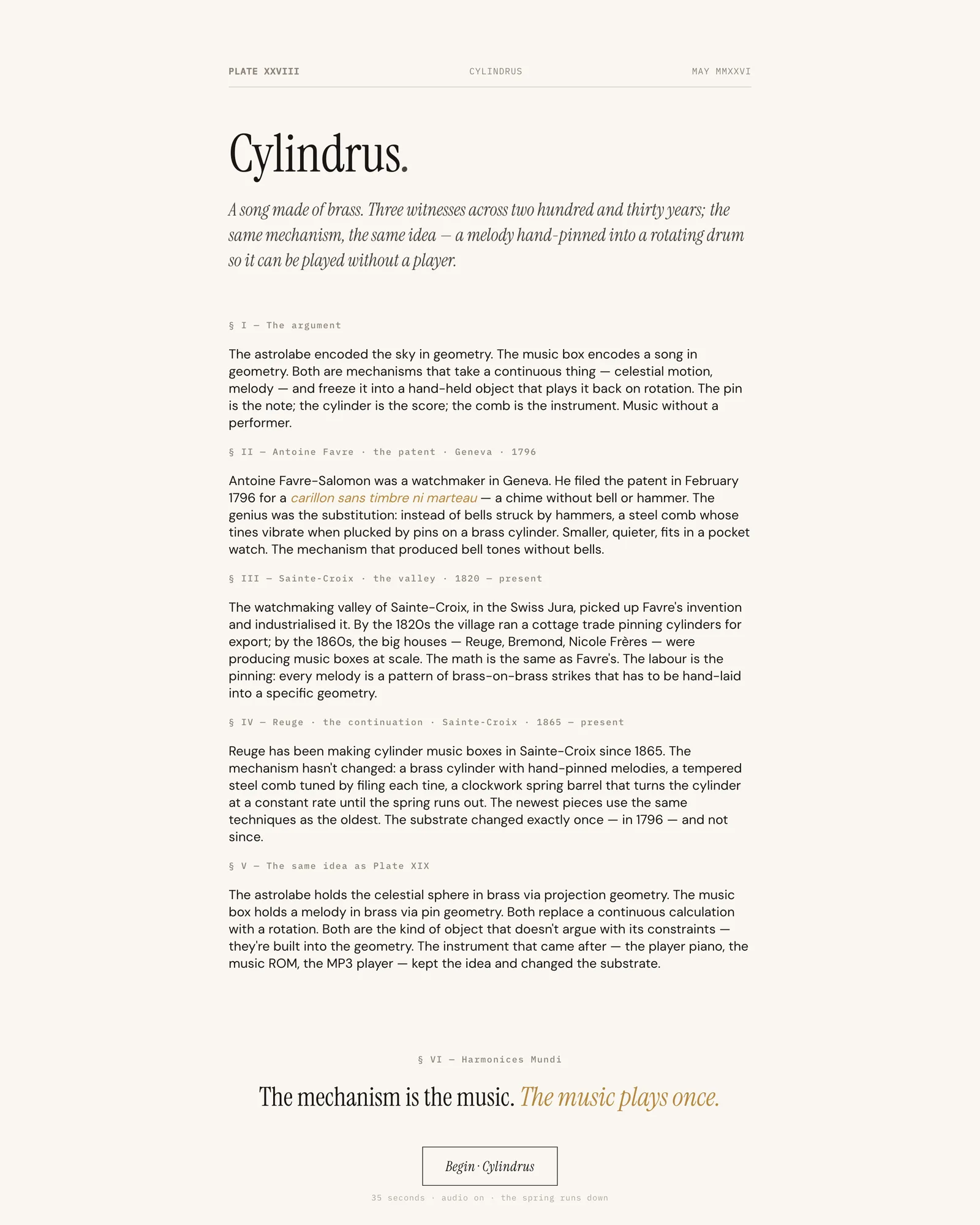 Plate XXVIIIJuly 2026
Cylindrus.
- the instrument keeps the time it was given.
A music box, made of the music we overlaid on the astrolabe. The measuring instrument that also plays.
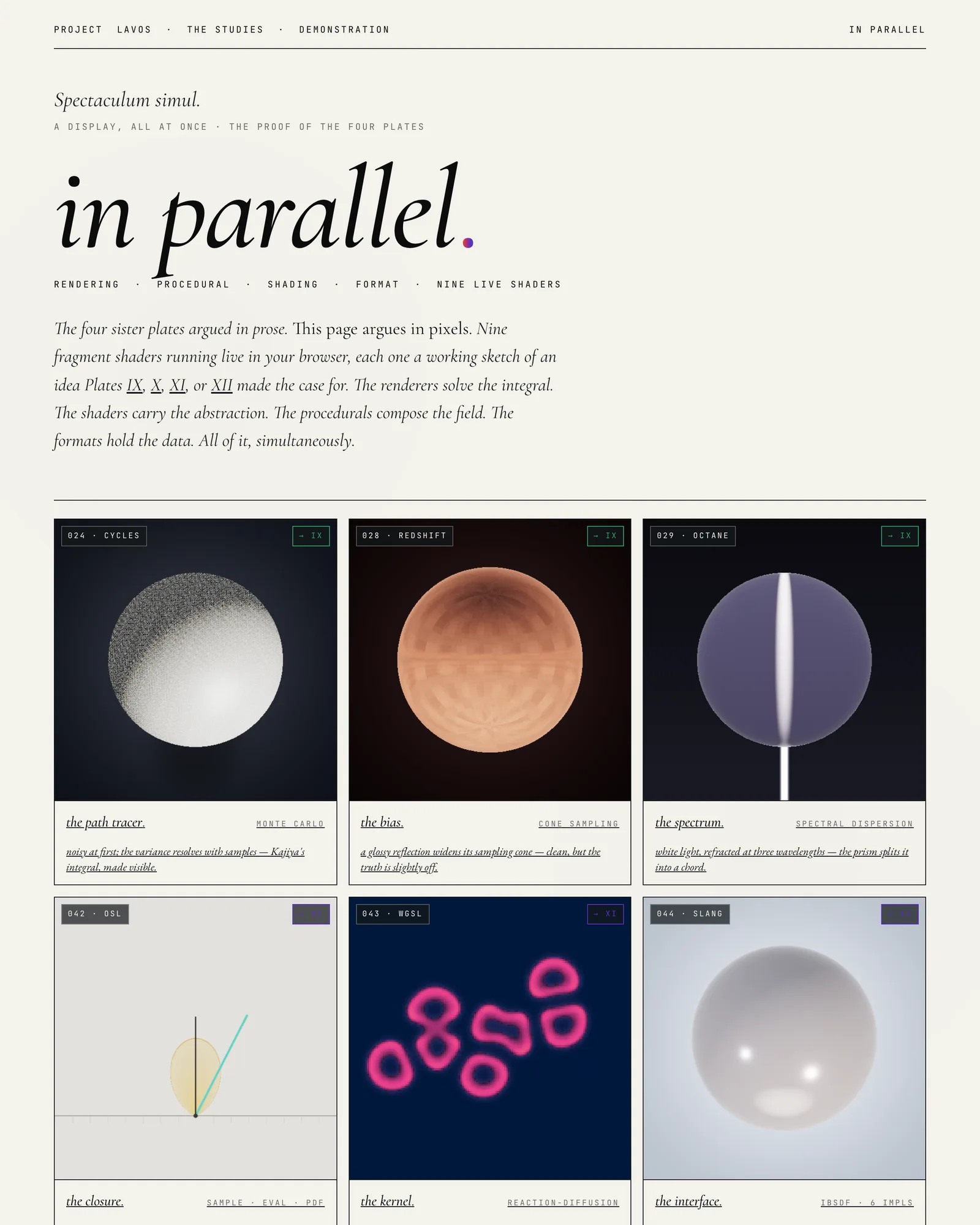 Plate XXIXMay 2026
In Parallel.
- all of it. running. now.
Nine live shaders running in parallel - the renderers, the shading languages, the procedural fields, and the data formats. Every idea Plates IX through XII argued, made visible at once.
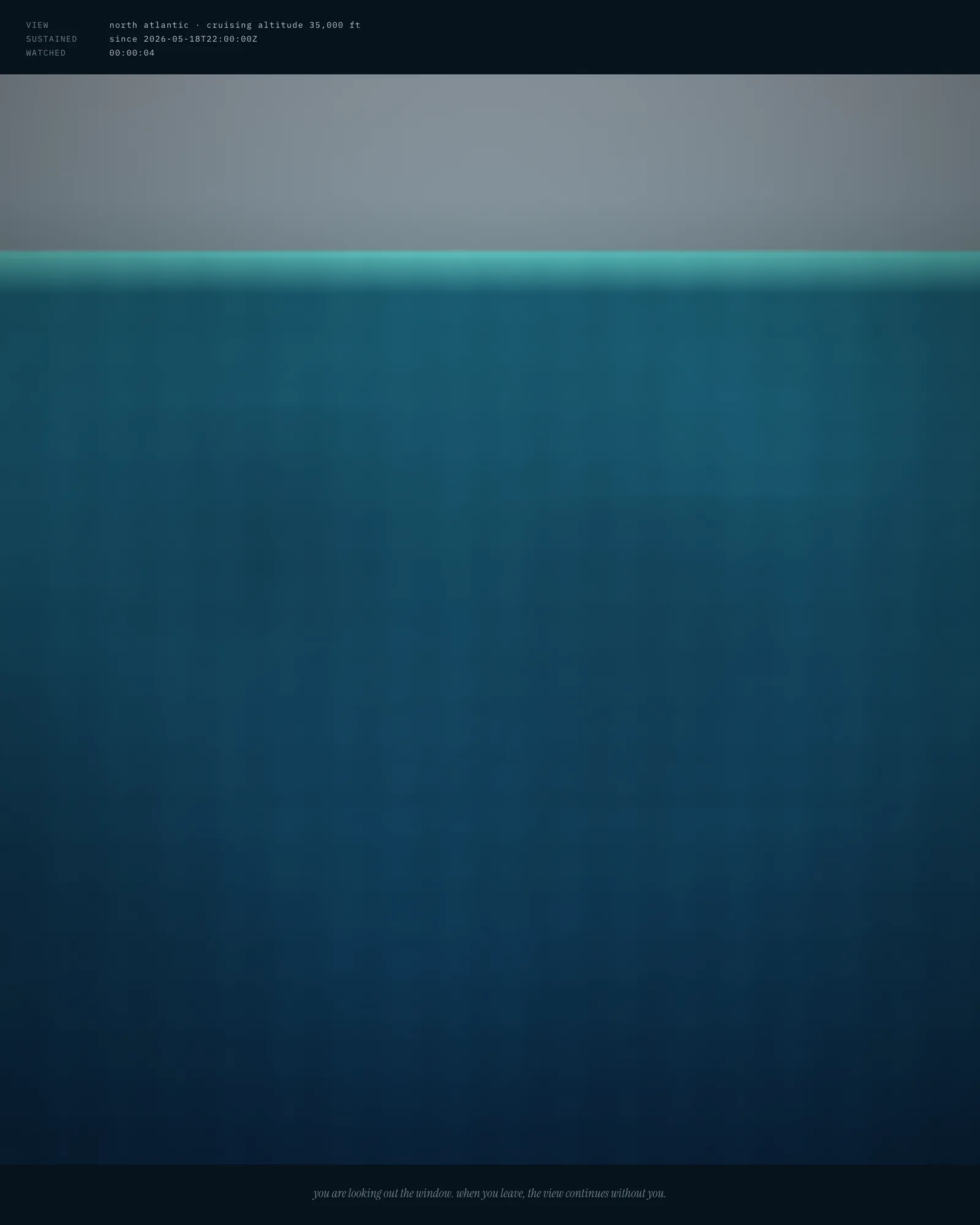 Plate XXXMay 2026
Vigil.
- sustained.
A view of the teal-blue threshold under the ocean, seen from altitude. Held, and held.
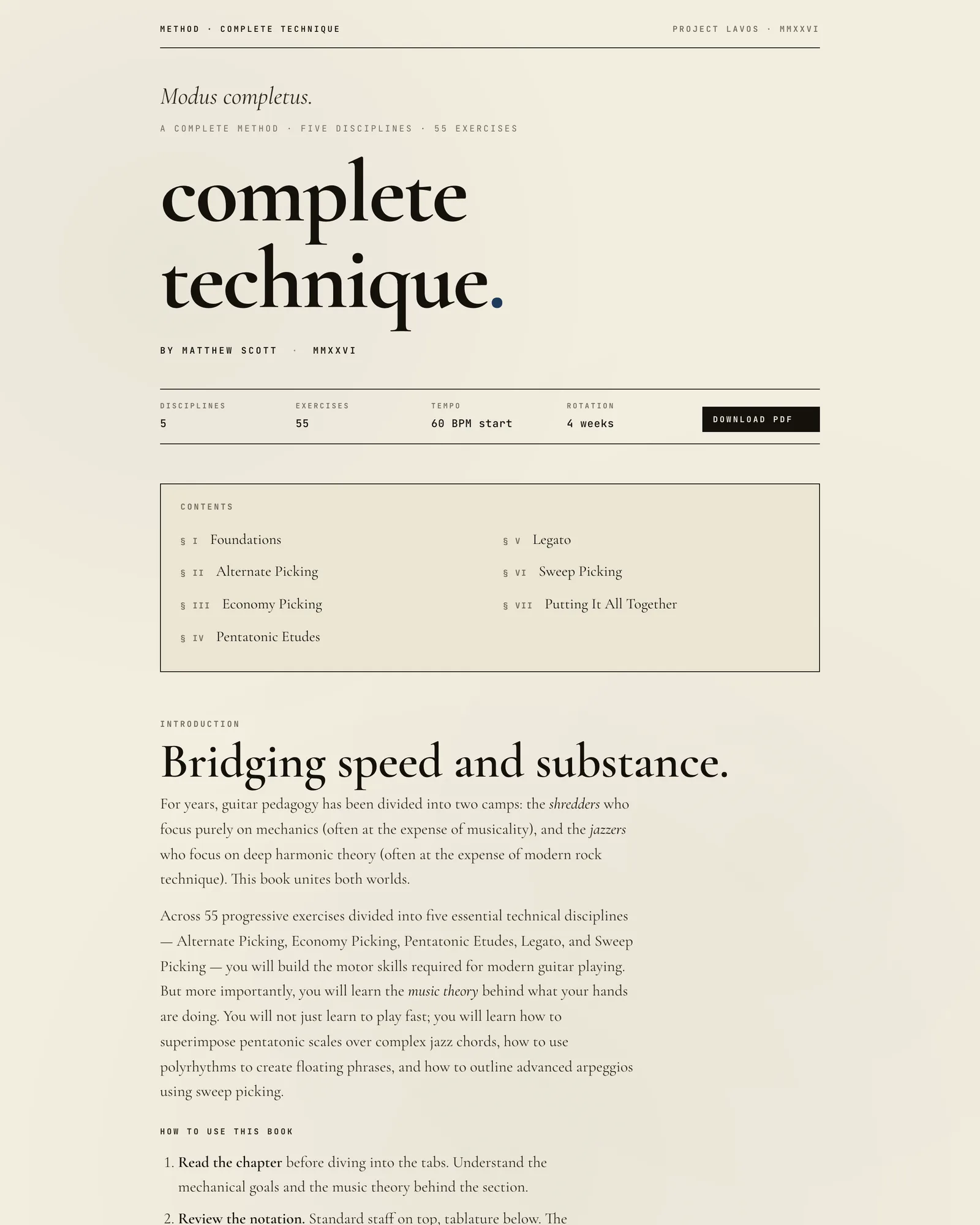 Plate XXXIApr 2026
Complete Technique.
- bridging speed and substance.
A modern guitar method. Five technical disciplines, fifty-five progressive exercises, and the music theory behind what your hands are doing - the pentatonic etudes practiced against the live grid at the tone specimen.
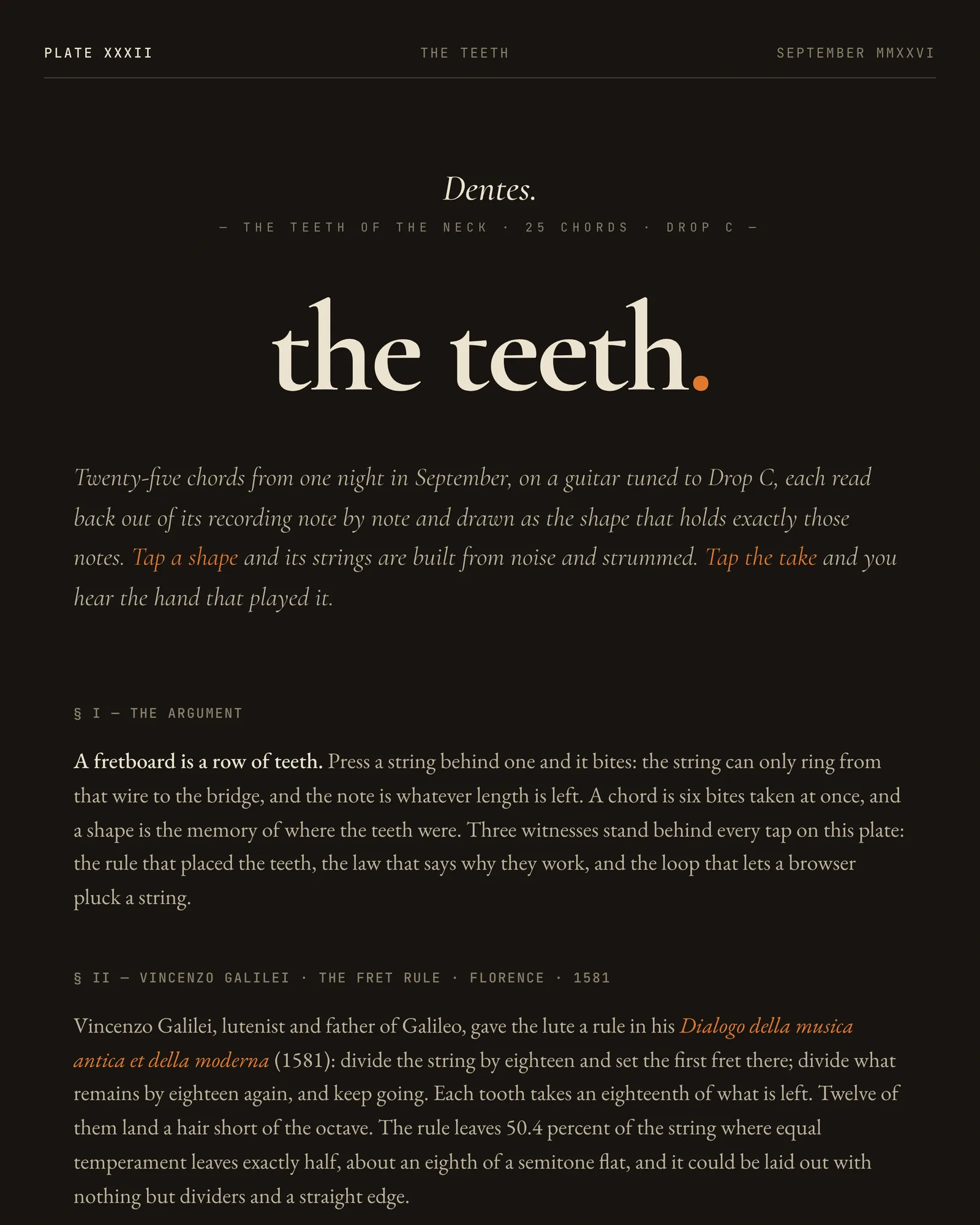 Plate XXXIISept 2026
The Teeth.
- the tooth is the note.
Twenty-five chords from one night in Drop C, drawn as the shapes that hold them. Tap a shape and it is strummed from noise, Karplus-Strong in the browser; tap the take to hear the recording. Three witnesses: Vincenzo Galilei's fret rule (1581), Mersenne's law of the string (1636), and Karplus and Strong's plucked string (1983).
Each plate is its own URL. Open one and the corpus speaks for itself.